بحث مخصص

الثلاثاء، 25 يناير 2011

How to Save Money When You Have No Money

Is it possible to save money when you have no money to save? This is an interesting question that I was able to answer and test for myself during the last few months.
Six months ago I had no money saved, not even a hundred dollars. It’s not that I was spending all of my earnings, but rather I was busy paying off taxes, plus I was moving to a new home in a new country and I had to pay an advance plus other things. Not my ideal situation financially speaking.
Despite that situation, I was able to implement a simple, easy to follow plan that allowed me to save some money each month. I didn’t really invent anything myself, but I think that everyone could benefit from this system, so I’m sharing it here.
Update: I should also mention that I used this method to pay more than 20,000 euros of debt (27,000 USD dollars) in 2008/2009. It really works.
Advantages of saving money
Before showing you the plan, I’d like to tell you what I believe are the major advantages of saving money with this method:
Less stress. By having a saving account with enough money to cover many months or years worth of your current expenses, you’ll feel less stress during the day. Even if you’d get fired tomorrow, you’d know that you’d have enough money to survive several months, and enough time to find a better job. After applying this simple method, this confidence will become a reality.
More discipline. The average person finds happiness through buying stuff, lots of stuff. When the average person receives a bonus or an increase in their salary, they quickly start to think about how they can spend those money. After starting this system however, you’ll quickly change your relationship with money. You’ll start to feel happy when you’re saving money rather than when you’re spending them. This alone, will allow you to become financial independent or rich.
You’ll get out of debt. When you start saving money this way, you’ll inevitably get out of debt, often faster than you ever thought possible thanks to the financial skills that you’ll learn by simply practicing this simple system.
Higher quality of life. Once you’ll have more financial freedom and you’ll have built enough discipline toward spending money, your quality of life will improve substantially. The decisions you’ll make about simple and complex situations like wherever or not to buy something, will be more thoughtful. You’ll develop the financial intelligence skills that will allow you to reach the top 20% of the population.
You’ll attract more money. Once you’ll understand and respect the value of money, you’ll start to receive more of them. The law of accumulation says that the more you have about something, the more you’ll ever have. The more money you’ll put apart, the more opportunities will be presented to you, and the more money you’ll make and save.
The system I’m about to explain is very simple, yet effective. The good news is that it works for everyone, no matter what their income is or how much debt they have to pay. When I first started with this method six months ago, I had zero savings, and a lot of expenses. Today, six months later, I reached my first milestone, which is the equivalent of one month worth of expenses, for me, and for my girlfriend. My goal is to save the equivalent of six months worth of expenses within the next year. Here’s how.
The plan, how you can start saving money today
The key principle of this system is to save something each month. How much is up to you based on your current situation, but you can start with as little as $20 or $30 a month. You can certainly save that amount of money each month, can’t you?
In my case I am saving 100 euros per month (starting with 200 euros from next month), which is the equivalent of about 135 US dollars. Not a lot of money, but enough. Remember that it’s not the amount of money that you decide to save that will eventually make you financially independent, but rather the process of doing it. Once you start doing it, everything will follow.
Here’s how the process work:
Before anything else, you need a separate bank account for your savings. I chosen ING Direct where I can withdraw the money at any time if I need, but you can use whatever bank you want. I’m not an expert and I accept feedback. Anyway, the point is that you should have a separate bank account for your savings, otherwise you’ll be tempted to spend them and it’ll be difficult to keep track. This point is very important, don’t skip it.
When your bank account is set up properly, put your first investment in it. It can be as little as $20, or whatever you can afford. Those will be the first money toward your financial independence.
After you made your first investment, decide in advance a day when each month you’ll put some money into your saving account. You can start with $20 a month if you want, but make sure that you put something each month. My advice is to choose a day just after you receive your paycheck in order for you to make less excuses.
Month after month, as you begin to save more and more money and you feel comfortable doing it, increase the amount that you put into your savings account each month. For example, if you were previously saving $20 a month, you can increase to $30 or $50.
When you receive a bonus or you feel comfortable doing it, put what you can into your savings account. By the law of accumulation, even if you decide to save $100 a month, after one year you’ll have more like $2,000 rather than just $1,200.
Finally, figure out how much money you need to live comfortable one month, including all the expenses that you currently have, and make a goal of saving the equivalent of six months worth of your expenses as soon as possible. It’ll probably take you one year or more to do this, but when that time will come you’ll be glad you started today.
If you follow this system, I’ll guarantee that you’ll feel better, have less stress, and eventually reach financial independence in the long term.
If for some reason during one month you have lots of expenses and you feel like you would not be able to save your usual amount of money, cut it in half, but save something anyway, even if it’s just $10. The process of doing it is always more important than the amount that you decide to save.
When to use the money you saved
Ideally, you should never touch those money. Those money are your private insurance that you’ll use whenever you lose your job or when you’ll have a major challenge in your life.
If you have debt to pay, don’t use those money. Instead, open a separate bank account and do the same process. You may feel like you’ll be saving less this way, but you’ll get out of debt sooner anyway.
What do you think about this system? Are you already using something similar? In a future post I’m going to write about the actual process of spending money and gaining financial intelligence.

30 Habits that Will Change your Life

Developing good habits is the basic of personal development and growth. Everything we do is the result of a habit that was previously taught to us. Unfortunately, not all the habits that we have are good, that’s why we are constantly trying to improve.
The following is a list of 30 practical habits that can make a huge difference in your life.
You should treat this list as a reference, and implement just one habit per month. This way you will have the time to fully absorb each of them, while still seeing significant improvements each month.
Health habits
Exercise 30 minutes every day. Especially if you don’t do much movement while working, it’s essential that you get some daily exercise. 30 minutes every day are the minimum recommended for optimal health.
Eat breakfast every day. Breakfast is the more important meal of the day, yet so many people skip it. Personally, I like to eat a couple of toasts in the morning along with a fruit beverage.
Sleep 8 hours. Sleep deprivation is never a good idea. You may think that you are gaining time by sleeping less, when in reality you are only gaining stress and tiredness. 8 hours are a good number of hours for most people, along with an optional 20 minutes nap after lunch.
Avoid snacking between meals. Snacking between meals is the best way to gain weight. If you are hungry, eat something concrete. Otherwise don’t. Update: for clarification, I mean don’t eat junk food between meals, but eating real food it’s ok.
Eat five portions of fruits and vegetables every day. Our body and brain loves getting vegetables and fruit, so I highly recommend eating as much of them as possible. Five portions is the dose that’s usually recommended by many health associations.
Eat fish. Fish is rich of omega 3 and other healthy elements. At least one meal per week of fish should be enough for getting all these nutrients.
Drink one glass of water when you wake up. When you wake up, your body is dehydrated and needs liquid. Make the habit of drinking one glass of water after you wake up in the morning. Also, drink more during the day.
Avoid soda. Soda is often one of the most unhealthy beverage you can find. Limit your consumption of soda as much as possible and you’re body will be grateful for that.
Keep your body clean. I don’t advise spending your day in front of the mirror, but a minimum of personal care does never hurt.
If you smoke, stop it. There’s no reason to smoke anymore, and quitting is possible.
If you drink, stop it. Same as above. Don’t think that alcohol will solve your problems. It never does. The only exception is one glass of wine per day during meals.
Take the stairs. This is just a hack that forces you to do a minimum of exercise. Instead of taking the elevator, take the stairs.
Productivity habits
Use an inbox system. Make the habit of keeping track of all the ideas and things that comes to mind. You can use a notebook to do this, and then sync everything on your computer.
Prioritize. If you have a list of things to do, where do you start? One way is to prioritize your list. If you are in doubt, ask yourself: “If I could only accomplish one thing today, what would it be?”
Plan, but not too much. Planning is important, and you should decide in advance what you are going to do today or this week. However, planning for more than a few weeks is usually inefficient, so I would not worry too much about that.
Wake up early. Waking up early in the morning is a great way to gain extra time. I personally like to wake up at 5 am, so that by 9 am I have already accomplished what otherwise would have taken me many days..
Check your email only twice per day. Email can easily become an addiction, but it’s usually unnecessary to check it every 10 minutes. Make an effort and check your email only once or twice per day, see if the world will still rotate as before after you try this.
Eliminate unimportant tasks. Being busy all day does not mean you are doing important stuff. Eliminate every activity that’s not important, and focus on what really matters.
Clean off your desk and room. Having a clear room and desk is important to maintain focus and creativity.
Automate. There are a lot of tasks that you need to perform every day or every week. Try to automate them as much as possible.
Set strict deadlines. When you do something, decide in advance when you’re going to stop. There’s a rule that states that you will fulfill all the time you have available for completing a task, so make an habit of setting strict deadlines for maximizing your productivity.
Take one day off per week. Instead of working every day, take one day off per week (for example sunday) where you are not going to turn on your computer. Use that time for doing recreational activities like going for a walk.
Personal Development habits
Read 1 book per week. Reading is a good way to keep your brain active. With just 30 minutes per day you should be able to read one book per week, or more than 50 books per year.
Solve puzzles. Quizzes, word games, etc. are all good ways to exercise your brain.
Think positively. You are what you think, all the time.
Make fast decisions. Instead of thinking for one hour wherever you are going to do something, make your decisions as fast as possible (usually less than 1 minute).
Wait before buying. Waiting 48 hours before buying anything is a tremendous money saver, try it.
Meditate 30 minutes per day. A great way to gain clearness and peace is through meditation. 30 minutes are not a lot, but enough to get you started with meditation.
Career habits
Start a blog. Blogging is one of the best way to put your word out. It doesn’t have to be around a specific topic, even a personal blog will do.
Build a portfolio. If your job is creating stuff, building a portfolio is a great way to show what you are capable of. You can also contribute stuff for free if that applies to your work.

The Secrets of Great Sales Management: Advanced Strategies for Maximizing Performance

Chapter 3: Crafting the Professional Sales Force
Overview
Whatever is worth doing at all is worth doing well. —LORD CHESTERFIELD Letters to His Son, March 10, 1746
Now that you have determined your objectives for today and tomorrow, the time has come to construct a sales force model. You may have already inherited a team of professionals, but following these steps from beginning to end will allow you to refine and develop personnel now and in the future.
Setting Out Your Goals

The best way to start is to put some specific measurements in place. Not just any measurements, but ones designed to specifically impact the short- and long-term goals you defined in Chapter 2. Some have called this ‘‘grounding the vision.’’ This means taking the goals out of the sky and placing them in the realities of your current situation.
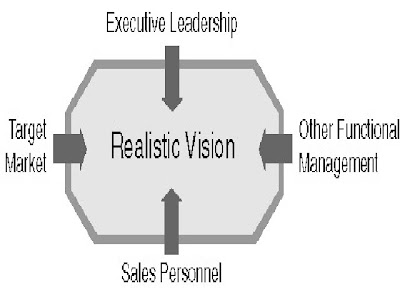
To do this, you will require a team of contributors, as shown in Figure 3-1.
Figure 3-1: Contributions to a realistic vision.
As Lewis Carroll said in Alice in Wonderland, if you don’t care where you are going, you are sure to get there if you walk long enough. Well, maybe in Mr. Carroll’s day, or in Alice’s new world, you could take as long as you needed to get somewhere, but not today! Not in this rapidly changing world of technology-based global business. You just don’t have that much time to reach success, so you’d better start establishing performance objectives and measurements.

Establishing Performance Objectives and Measurements
One thing to keep in mind is that you cannot do it ‘‘the same old way.’’ That would be like trying to drive an old oversized luxury car from the 1950s today. It may be beautiful to look at and comfortable to ride in, but the quality, gas mileage, and shortage of technologies will make it useless for anything but an antique auto exhibit.
There are four areas to consider when creating or setting performance objectives. These are:
Needs of the business
Performance needs
Training needs
Work environment needs
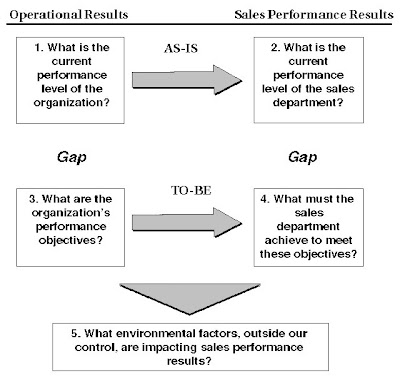
Do you notice the sequence? The order of solutions has usually been found to work best when you follow the above sequence. Remember, the sales department is not an island unto itself. You are performing the sales function to meet some organization-wide need(s), so start with the needs of the business and progress to the needs of the work environment. As you look at any desired performance objective, construct a process improvement analysis that looks like the one in Figure 3-2.

Figure 3-2: Linking performance to gap closure.
Step 1: What Is the Current Performance Level of the Organization?
How are its measurements compared to where they should be right now? How is your overall organization performing against its stated objectives and goals? If you aren’t sure, sit down with the leadership and find out.
What is the current sales organization’s contribution to the organization’s overall current performance? Be honest and explore this subject as you develop your performance improvement plan. Be realistic in a manner that will be relevant to all concerned. Don’t deny or minimize your department’s contribution to a shortfall in goal attainment by the company. At the same time, don’t fall on a sword that is not of your creation. Be honest so that you will be perceived by all as a true member of the organization’s management team.
Step 2: What Is the Current Performance Level of the Sales Department?
Identification of current performance and organizational obstacles. Now that you know what performance levels you need to have as a sales organization, take a look at where you are now. Don’t generalize with such concepts as ‘‘we aren’t very good’’ or ‘‘we don’t make enough sales.’’ Be specific. In what performance areas are you currently lacking, and by exactly how many sales are you falling short? This analysis will give you a starting point to measure success in the coming months and years.
Also, be realistic about organizational obstacles that might make it difficult to improve. Just because these challenges exist, however, does not mean you can treat them as excuses. If it were that easy, anybody could do your job. You are being paid to mitigate or find a way around the obstacles.
Relative importance of all performance results. As you look at the current performance results, identify and categorize them enough to be able to prioritize or rank them in their importance for meeting the desired performance requirements demanded by your answers to Step 1. Everyone is limited by time, money, tools, and people. Make sure that you are working on the performance standards that will have the greatest impact on the successful achievement of your goals. This works for you in two ways. First, it helps keep the entire organization supporting your plans. Second, it keeps your sales team engaged since the performance improvement that you require of them is directly linked to organizational success and is not perceived as just busy work.
Current skills to perform as required. Ask yourself specifically, what are the current skills of the sales team members (or those currently performing the sales function) in areas that have an impact on the highest priorities identified in the last question? If you have a sales team now, analyze each of them individually, not as a team. This will allow you to develop a performance improvement plan for each, rather than grouping them all together in an ill-defined initiative.
Obstacles to performance. Make sure you consider any current obstacles that need to be addressed to reach your, and the organization’s, goals. Be realistic since some of them, such as current compensation models, HR-controlled benefits programs, inadequate product portfolio, insufficient supportive technology, available talent pool, decline in addressable markets, might affect your success.
Skill gaps. This point is very important. Based on your analysis of what is needed to perform at the level required to meet organization or corporate objectives and the current level that the performance is at today, what is the gap? Whether it is per sales person or per the entire team, you now have a starting point, a finish line, and a distance you have to traverse to be successful. This gap will help you set the intermediate goals and milestones of measurement to communicate to the world that you are doing a great job.
Step 3: What Are the Organization’s Performance Objectives?
Identification of internal business goals and challenges. As we said in the previous chapters, a sales manager must always be focused on the organization’s goals, objectives, and challenges. Make sure you have a very clear understanding of the vision for the future held by the leadership of your business, association, or organization. Don’t make assumptions, have preconceived ideas, or jump to conclusions based on partial data. Sit down with your leaders and ask them specifically what performance level would they like to see the organization achieving. Not just the sales team, but the entire organization. Make sure that they discuss their views of what obstacles or challenges might lie in the way.
Identification of customer goals and challenges. Additionally, review your S.W.O.T. on the customer segment you are targeting. Consider the goals and challenges of your most important customers. More than a few successful sales managers have engaged their targeted market in the performance-setting process for their sales team.
Understanding the implications of performance as viewed by both functional management and the customer. The next action for Step 3 is to explore the way your organization’s management team perceives the contribution that the sales organization can make to achieve the overall organizational objective. This is critical! You must understand their view of the role of sales. It might surprise you.
Step 4: What Must the Sales Department Achieve to Meet These Objectives?
Identification of required performance results. Now, find out your required contribution to the organization’s overall goal attainment. You can’t bear the whole burden on your shoulders, but as the initiating department for new orders, you do share a significant portion of the burden for organizational success. Be realistic about what sales performance levels are required of your team and don’t get bogged down in the ‘‘we can’t do that’’ mode of thinking. You can do just about anything if you address realities in your planning. Link your team’s contribution to some form of performance evaluation that is clear, concise, and measurable. Clear means that any reader will be able to understand it. Concise means it is to the point without bombastic wordage. Measurable means you are able to determine the impact. It might be a specific increase in gross margins on the average sale. Or it might be an increase in cost reduction through an increase in order entry quality as measured by returned orders. It could be issues related to customer retention as measured by lost customer rate. It might even be a reduction in internal conflicts between the sales department and other organizational departments as measured by cross-organizational surveys. Remember, if you can’t measure it, it doesn’t belong in the performance standards.
Identification of customer’s required performance model. Spend some time with your most important customers, those you can’t afford to lose, and find out what they require in a sales professional that provides solutions to their business challenges. Make sure you focus on the field and hierarchal level you are selling into, such as IT management or enterprise-wide directorships, so the data will be clear about the point of interaction.
Identification of senior management’s required performance model. Here we are analyzing, in partnership with our senior management, the requirements for a sales performance model. In other words, we understand from previous questions how they perceive the sales department in regard to its contribution to overall organizational success. But what departmental design or model do they require? In some organizations, the senior management or leadership demands accessibility to the sales team with some form of ability to influence daily activities. In other organizations, senior management prefers that the sales team be part of the marketing department or customer service. In others, you might have complete autonomy and independence. You can’t simply shape a perfect sales model and establish performance objectives without senior management’s input on a required or desired departmental model.
Agreement with sales personnel for skills development actions. Whether they are new kids out of the gate or old seasoned veterans, you now have the basis for communicating to your sales personnel a plan for improving the skills that are necessary to meet organization goals and objectives, as outlined in individual performance improvement plans. You will get a greater acceptance of the plan and an agreement by your team to being measured by the new standards of performance because they are directly linked to the goals of the organization as a whole.
Agreement with senior management for skills development actions. To ensure the support and confidence of your senior management team, as well as cross-organizational support, gain the agreement of your leadership to your specific plan of action to improve performance results. As you might be aware, leaders do not like surprises, and if they encounter any, you surely don’t want them to come from your sales plan.
Step 5: What Environmental Factors Outside Your Control Are Impacting Performance Results? What is the current state of your organization? As you step back and look at your company or association, what are the realities? I have been called in many times to work with companies that are in decline because of a lack of interest by the ownership or a disappearing target market. I’ve also been called in to situations where the global companies are challenged to communicate effectively in diverse cultures, where there is a demand for different approaches to success in localized markets. I don’t mean that we just give up in these situations, but we must incorporate them into a plan that accounts for any realities we need to work around and through if we want to attain success.
What is the current state of the business drivers we talked about in Chapters 1 and 2? Remember the business drivers? The current, trending, and future of each must be incorporated in your sales plan if it is to have any validity.
Technology (hardware and/or software)
Globalization
Competition
Customers
Demographics
Lifestyles
Psychographics (consumer sentiment)
Firmographics (business sentiment)
Economy
Regulatory practices
Business practices
Be honest and explore each of the previous questions as you develop your performance improvement plans, and as you do, ask yourself the following questions:
How good is your business intent? Is it in complete alignment with all realities?
What are the key business drivers mentioned previously that will have the greatest impact on success?
What do you know about the internal environment? Do you need to know more, and where will you go to get that information?
What do you know about the external environment? Do you need to know more, and where will you go to get that information?
Raising the Bar for Existing Sales Team Members
As you set performance standards for your team members, you must establish ones that will drive a higher and higher level of performance from your existing sales personnel. As I mentioned previously, you cannot do this as a group, but rather from the unique individuality of each person. No matter what you are creating as a new expectation, each person will be starting from a different point in his or her control and understanding of the performance skill set.
Measure where your team members are, where you want them to be, how much time is available to improve their performance skills, and what their rate of learning is. Also, develop a performance improvement plan that is based on where you want them to be both in the short term and twelve months from now.
The one key to performance improvement for existing team members is that they must recognize and understand the relevance of the performance standard to the business environment. If they don’t, they will be hesitant and resistant.

Using the New Performance Standards to Hire
It can be much easier to set standards for the new hires. Add any required performance skills to a list you will be creating in the next chapter. It will make hiring much easier since you can now specifically measure all possible candidates, both internal and external, against a valuable competencies scale.
But, remember, you cannot have a performance standard for new hires that is different from the one for existing team members. This will only lead to dissatisfaction and complications in the compensation program, as well as possible legal problems for you and the company. Make sure that you are being fair to all team members.

Chapter Summary
In this chapter we discussed the need for establishing clear, reasonable performance measurements for each and every team member. Rather then being constructed arbitrarily, this is done by linking the approach to internal and external factors, gap analysis, and the overall organizational business plan. The resulting performance analysis can be used both to raise the bar for existing team members and to set equally high standards for new hires.

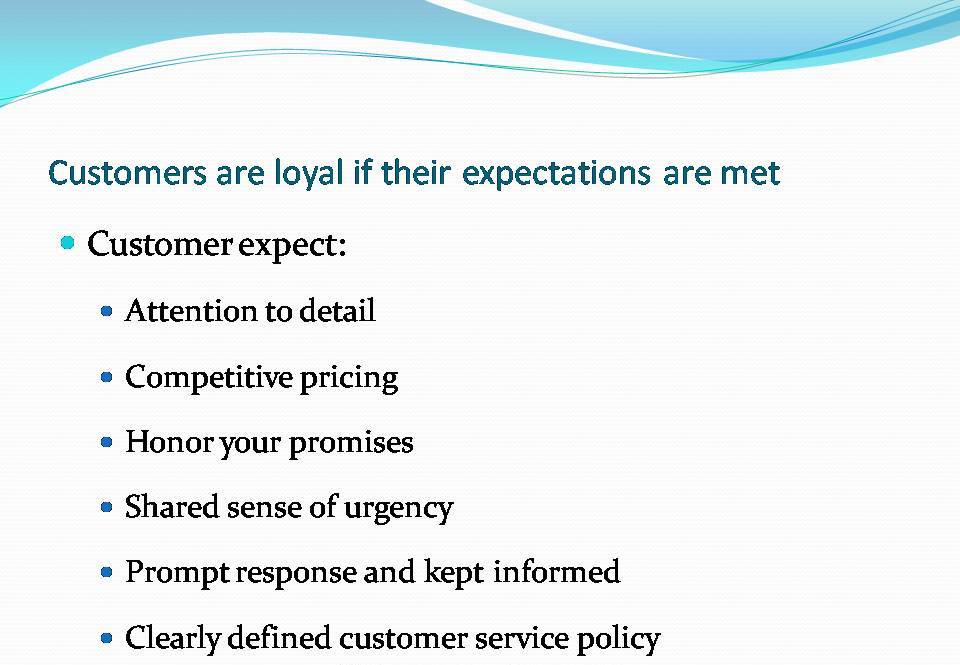
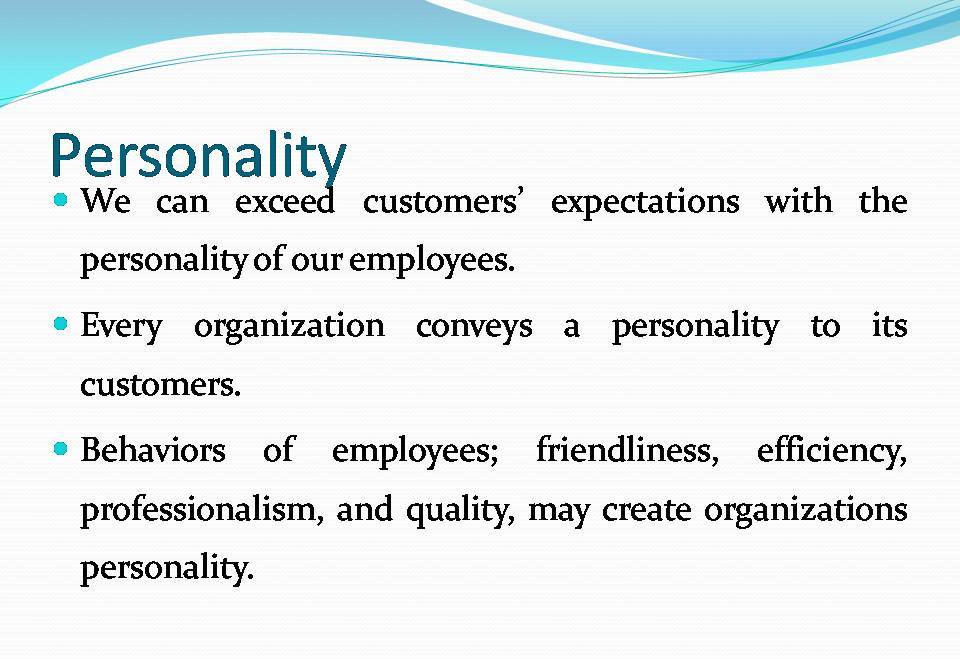
Marketing Course Lecture two – Customer loyalty

الأعـمـال بسرعة الخاطرة الباب الأول تدفق المعلومات هو قوام حياتك الفصل الأول الإدارة بقوة الحقائق

قوام سداد الحكم في مجال الأعمال هو العثور على الحقائق والأحوال الخاصة بالتقنية والسوق، وما شابهها، والتعرف عليها في صورها المتغيرة باستمرار. إن سرعة التغيير التقني الحديث يجعل البحث عن الحقائق سمة ضرورية على الدوام.
الفريد ب. سلون:
" سنواتي مع جنرال موتورز"
ليّ معتقد بسيط لكنه قوي وهو أن الطريقة الأجدى لتمييز شركتك عن منافسيك، الطريقة الأفضل لوضع مسافة بينك وبين المتزاحمين، هو أن تفعل بالمعلومات شيئاً ممبزاً. إن الكيفية التي بها تَجمع المعلومات وتعللجها وتستعملها سوف تحدد ما إذا كنت من الفائزين أم الخاسرين. هناك الكثير من المنافسين. هناك الكثير من المعلومات المتاحة عنهم وعن السوق.. والذي هو الآن عالمي. سيكون الفائزون هم أولئك الذين يطورون نظاماً عصبياً رقمياً عالمياً يتيح للمعلومات أن تتدفق بسهولة خلال شركاتهم من أجل التعلم الأمثل والدائم.
كأني بك ترد: كلا، بل إن الفيصل هو العمليات الكفؤة! هو الجودة! هو شهرة الصنف والسعى وراء الحصة السوقية! هو الاقتراب من العملاء! بالطبع يعتمد النجاح على كل هذه الأشياء؛ فما من أحد يستطيع مساعدتك
إذا كانت عملياتك متعثرة .. إذا لم تكن يقظاً بشأن النوعية .. إذا لم تعمل جاهداً لتوطيد صنفك .. إذا كانت خدمتك للعملاء دون المستوى. إن الاستراتيجية السيئة ستفشل مهما كانت جودة معلوماتك، كما أن التنفيذ الأعرج يحبط الاستراتيجية الجيدة. إنك إذا أسأت أداء ما يكفي من الأشياء فسيكون مآلك الخروج من ساحة الأعمال.
ولكن مهما كان ما تتمنع به اليوم ـ موظفين حاذقين، منتجات ممتازة، رضا العملاء، سيولة نقدية في المصرف ـ فإنك تحتاج إلى تدفق سريع من المعلومات الجيدة لتسليس العمليات والارتقاء بالنوعبة وتحسين تنفيذ الأعمال. معظم الشركات لديها أناس جيدون يعملون لها ومعظم الشركات تريد فعل ما يرضى عملائها. ثمة بيانات مجدية موجودة في مكان ما داخل أغلب المؤسسات. إن تدفق المعلومات هو قِوام حياة شركتك لأنه يساعدك على استخلاص أفضل ما لدى عامليك والتعلم من عملاءك. انظر إذا كانت لديك المعلومات اللازمة للإجابة على هذه الأسئلة:
l ما رأي عملاءك في منتجاتك؟ ما هي المشاكل التي يطالبونك بحلها؟ وما هي السمات الجديدة التي يطالبونك بإضافتها؟
l ما هي المشاكل التي يلاقيها موزعوك وبائعوك أثناء بيع منتجاتك أو أثناء عملهم معك؟
l أين يكسب منافسوك أعمالاً منك، ولماذا؟
l هل متطلبات العملاءالمتغيرة تدفعك إلى تطوير مقدرات جديدة؟
l ماهي الأسواق الجديدة الناشئة التي ينبغي لك أن تدخلها؟
لن يضمن لك جهاز عصبي رقمي الإجابات المناسبة على هذه الأسئلة وإنما سيخلصك من أطنان من العمليات الورقية القديمة حتى يكون لديك الوقت أمام ناظريك كى تتمكن من رؤية الاتجاهات وهى مقبلة عليك. من شأن جهاز عصبي رقمي أيضاً أن يجعل من الممكن ظهور الحقائق والأفكار سريعاً من أسفل في مؤسستك.. من اؤلئك الذين لديهم معلومات عن هذه الأسئلة ـ وربما العديد من الأجوبة. والأهم من هذا وذلك هو أنه سيساعدك في القيام بكل هذه الأشياء على جناح السرعة.
إلإجابة على الأسئلة الصعبة
تقول نكتة قديمة في مجال الأعمال إن السكك الحديدية لو أدركت أنها تنتمي إلى مجال النقل وليس إلى مجال قضبان الصلب لكنا الآن طائرين على متن خطوط "يونيون باسيفيك" الجوية. هناك منشآت عمل عديدة قامت بتوسيع مهامها أو تغييرها بطرق أشد جوهرية من هذه؛ فصانعة غير موفقة لأول مطهاة أرز كهربائية في اليابان تتطورت للتصبح شركة سوني، إحدى متصدرات العالم في الإلكترونيات الاستهلاكية والتجارية وفي صناعتى الموسيقى والأفلام. وثمة شركة بدأت بصنع آلات لحام وأجهزة استشعار ممرات البولينغ وآلات تخفيض الوزن ثم انتقلت إلى مرسمات التذبذب والحواسيب لتصبح ما نعرفه اليوم بـ"هويليت باكارد". لقد تتبعت هذه الشركات السوق فأحرزت نجاحاً خارقاًً، ولكن معظم الشركات لا تستطيع فعل ذلك.
بل حتى لو نظرت إلى مجال عملك الحالي فليس من الواضح دائماً أين تكون فرصة النمو التالية. تتمتع شركة ماكدونالز في عالم الوجبات السريعة المضطرب بأقوى اسم صنف وأكبر حصة سوقية وسمعة طيبة من ناحية النوعية، ولكن أحد محللي السوق اقترح مؤخراً أن تبدّل ماكدونالدز نمط عملها؛ فقال مشيراً إلى اهتمام الشركة أحيانا بانتاج دُمى مستوحاة من الأفلام السينمائية إن على ماكدونالدز أن تسنخدم سندوتشات الهامبيرجر ذات الهامش المنخفض لتبيع خطاً من دمى ذات هامش مرتفع عوضاً عن االقيام بالعكس. ومع أن تغييراً كهذا أمر مستبعد لكنه ليس مما لا يمكن التفكير فيه في عالم الأعمال الراهن المتغير سريعاً.
العبرة المهمة هنا هى الأ تأخذ شركة موضعها في السوق كأمر مسلم به، بل عليها أن تعيد التقييم باستمرار. فرب شركة ستحقق فتحاً مبيناً في مجال آخر من مجالات الأعمال ورب أخرى ستجد أنها ينبغي أن تلزم ما تجيد معرفته والقيام به. والشيء الأهم هو أن تكون لدى مدراء الشركة المعلومات اللازمة لفهم مزيتهم التنافسية وماهية سوقهم الكبير التالي.
سوف يساعدك هذا الكتاب على استعمال تقنية المعلومات لتوجيه الأسئلة الصعبة وكذلك للإجابة عليها بشأن ماذا ينبغي أن تكون أعمالك وأين ينبغي لها أن تذهب. تتيح لك تقنية المعلومات الحصول على البيانات التي تؤدي إلى الفهم النافذ لأعمالك. إنها تمكّنك من التصرف بسرعة، وتتيح حلولاً لمشاكل العمل لم تكن ببساطة متوفرة من قبل. إن تقنية المعلومات والأعمال تصبحان الآن مترابطين ترابطاً لا فكاك منه. ولا أعتقد أن أي شخص يمكن أن يتحدث حديثاً ذا معنى عن أحدهما بدون أن يتحدث عن الآخر.
اتخاذ نهج موضوعي قائم على الحقائق
الخطوة الأولى في الإجابة على أي سؤال صعب متعلق بالأعمال هى اتخاذ نهج موضوعي قائم على الحقائق. هذا المبدأ، الأسهل قولاً عن العمل به، موضح في كتاب الأعمال الذي أفضله: "سنواتي مع جنرال موتورز" لألفريد ب. سلون، الابن. إذا كنت تقرأ كتاباً واحداً عن الأعمال فعليك بكتاب سلون (ولكن لا تترك هذا الذي في يدك لتفعل ذلك). إن من الملهم أن يرى المرء في رواية سلون عن حياته العملية كيف أن القيادة الإيجابية الرشيدة المركزة على المعلومات يمكن أن تقود إلى نجاح ساحق.
أثناء فترة إدارة سلون التي امتدت من 1923 إلى 1956 أصبحت جنرال موتورز إحدى أوائل مؤسسات الأعمال المعقدة حقاً في الولايات المتحدة. لقد فهم سلون أن أى شركة لا يمكنها تطوير استراتيجية كاسحة أو الاضطلاع بمشروعات مناسبة دون أن تبني على حقائق ورؤى من الأشخاص في المؤسسة. وقد طوّر فهمه الخاص به للأعمال من تعاونه الشخصي اللصيق مع الفنيين واختصاصي الأعمال من معاونيه وبزياراته الشخصية المنتظمة لمرافق الشركة الفنية، غير أن تأثيره االأكبر كمدير جاء من الطريقة التي أقام بها علاقات عمل مع موزعي جنرال موتورز على امتداد القطر؛ فقد دأب على جمع معلومات من موزعي جنرال موتورز وأنشأ معهم علاقات وثيقة مثمرة.
استفاد سلون كثيراً من رحلات لتقصي الحقائق. لقد أعد ّعربة خصوصية من عربات السكة الحديد كمكتب له وجاب كل أرجاء البلاد زائراً موزعي الشركة، وكان في الغالب يلتقي ما بين خمسة وعشرة منهم يومياً. كان يريد أن يعرف ليس فقط ما تبيعه جنرال موتورز للموزعين بل وما يباع من الحصص المخصصة لهم. وقد ساعدت هذه الزيارات سلون على أن يدرك في أواخر العشرينيات أن الأعمال في مجال السيارات آخذة في التغيير؛ فالسيارات المستعملة باتت الآن وسيلة المواصلات الأساسية، وبات المشترون من ذوي الدخل المتوسط يبتاعون سيارات جديدة أفخر بفضل نظم البيع بالتقسيط والمقايضة الجزئية [شراء سيارات جديدة بقديمة مع دفع الفرق]. أدرك سلون أن هذا التغيير يعني أن لب علاقة جنرال موتورز بالموزعيين يجب أن يتغير أيضاً بانتقال الأعمال في مجال السيارات من مسألة بيع إلى متاجرة. لقد بات على الصانع والموزع تطوير علاقة أشبه بالشراكة. قام سلون بإنشاء مجلس موزعين يتقابل بانتظام مع كبار تنفيذيي جنرال موتورز بمقر الشركة، كما أنشأ هيئة لشؤون الموزعين تتولى شكاوى المزعين وأجرى دراسات اقتصادية لتحديد أفضل المواقع لإقامة مراكز توزيع جديدة، بل إنه ذهب إلى أبعد من ذلك بإرساء سياسة مفادها المجازفة بتمويل أكفاء الرجال ممن لم يكن لديهم رأس مال جاهز لإنشاء مراكز توزيع.
بيد أن المعلومات الدقيقة بشأن المبيعات ظلت عسيرة المنال؛ فقد كانت أرقام مبيعات جنزال موتورز غير متسقة وغير مستحدثة وناقصة. كتب سلون: "عندما كان الموقف الربحي للموزع يعتل لم يكن أمامنا سبيل لمعرفة ما إذا كان ذلك بسبب مشكلة سيارة جديدة أم مشكلة سيارة مستعملة أم مشكلة خدمة أم مشكلة قطع غيار أم مشكلة أخرى. وبدون حقائق كهذه كان من المستحيل وضع أي سياسة توزيع سليمة موضع التنفيذ." قال سلون إنه كان على استعداد لأن يدفع "مبلغاً ضخماً" ويحس بأنه "محق تماماً في ذلك" إذا كان كل موزع "يستطيع معرفة الحقائق المتعلقة بأعماله ويتعامل مع التفاصيل العديدة… بطريقة ذكية". كان سلون يعتقد أن مساعدة الموزعين في مسائل المعلومات هذه "سيكون أفضل استثمار قامت به جنرال موتورز إطلاقاً".
من أجل مواجهة هذه الإحتياجات وضع سلون نظاماً قياسياً للمحاسبة على نطاق جنرال موتورز وكل مراكز توزيعها. والكلمة المهمة هنا هي كلمة "قياسي"؛ فكل موزع وكل مستدخَم على كل مستوى في الشركة كان يصنِّف الأرقام بنفس الطريقة تماماً. وبحلول منتصف الثلاثينيات بات بوسع موزعي جنرال موتورز وأقسامها الخاصة بالسيارات ومكاتبها الرئيسية اأن تقوم جميعاً بتحليل مالي مفصَّل باستعمال نفس الأرقام. فمثلاً كان باستطاعة مركز للتوزيع أن يقيس ليس فقط أداءه هو بل أداءه إزاء متوسطات المجموعات الأخرى.
لقد كان من شأن بنية تحتية أتاحت معلومات دقيقة أن أدت إلى مؤسسة متجاوبة لم تستطع الشركات الأخرى لصناعة السيارات أن تدانيها مثيلاً لعقود من الزمان. ساهمت تلك البنية التحتية، التي أسميها "جهاز الشركة العصبي"، في هيمنة جنرال موتورز على صناعة السيارات طوال حياة سلون المهنية. ولم تكن حينذاك رقمية بعدُ إلا أنها كانت ثمينة للغاية. كانت معرفة مخزون الموزع أمراً تجيده جنرال موتورز أكثر من غيرها، وقد نالت جنرال موتورز مزية تنافسية هائلة من استغلال تلك المعلومات. وتجاوزت هذه الاستفادة من المعلومات جدران جنرال موتورز؛ فقد استعملت جنرال موتورز نظم معلومات كُتيبية لبناء أول "اكسترانيت"ـ شبكة تربط الشركة بمورديها وموزعيها.
بالطبع لم يكن في إمكانك الحصول على معلومات تتدفق خلال شركتك آنذاك بمثل الكم الذي يمكنك الحصول عليه الآن؛ فالأمر كان سيقتضي مكالمات هاتفية جد كثيرة وأناساً جد كثيرين يتناقلون أوراقاً وينكبون على سجلات ورقية محاولين الربط بين البيانات والعثور على الأنماط. كان ذلك سيكلف باهظاً. وإذا أردتَ اليوم إدارة شركة ذات مستوى عالمي فعليك أن تذهب إلى أبعد من ذلك بكثير وتنجز بأسرع من ذلك بكثير. إن الإدارة بقوة الحقائق ـ والتي هو أحد أساسيات الأعمال لدى سلون ـ تتطلب تقنية المعلومات. لقد تغير تغييراً درامياً ما تطيق الشركات القيام به وما ترى أنه يستحق القيام به وما بمقدورها تنافسياً القيام به.
تستعمل جنرال موتورز الآن تقنية الحاسوب الشخصي ومقاييس الإنترنت للاتصال بعملائها؛ فحلها المتمثل في منظومتها المسماة "جي ام أكسس" يستعمل شبكة للشركة واسعة النطاق تستخدم الأقمار الصناعية للتعامل بين مقر الشركة ومصانعها وموزعيها البالغ عددهم 9000، والذين لديهم أجهزة متصلةعلى الخط الإلكتروني ((online لأغراض الإدارة المالية والتخطيط التشغيلي بما في ذلك إدارة الطلبات الإجمالية وتحليل المبيعات والتنبؤ بها. وتقوم أداة بيع تفاعلية بالجمع بين سمات المنتجات ومواصفاتها وتسعيرها وغيرها من المعلومات. ويحظى فنيو خدمة المنتجات بوصول فوري إلى أحدث المعلومات عن المنتجات وقطع الغيار من خلال كتيبات الخدمة الإلكترونية والنشرات الفنية وتخطيط قطع الغيار وإعداد تقارير المخزون على الخط الحاسوبي. يربط البريد الإلكتروني الموزعين بمقر جنرال موتورز ومصنعها وببعضهم بعضاً. يتم دمج الحل الذي يأتي به الموزع الخاص في موقع جنرال موتورز العام على الإنترنت حيث يجد العملاء معلومات تفصيلية عن السيارات. توفر تقنيات الإنترنت الأساس لتحول جوهري في الطريقة التي بها يتسوّق المستهلكون السيارات، فلا غرو أنهم يضعون جنرال موتورز كهدف للتجارة الإلكترونية. وبالطبع عمدت شركات صناعة السيارات الأخرى كذلك إلى تحسين أنظمة معلوماتها؛ فتويوتا تحديداً استخدمت تقنية المعلومات لتطوير انتاج صناعي على مستوى عالمي.
تمييز شركتك في عصر المعلومات
إذا كانت إدارة المعلومات واستجابة المؤسسة قد أحدثتا مثل هذا الاختلاف في صناعة تقليدية من ذات المداخن قبل سبعين سنة فأي تمييز أكثر ستُحدثانه مدفوعتين بالتقنية؟ قد يكون لأي شركة حديثة لصناعة السيارات اسم تجاري قوي وسمعة لنوعية جيدة في يومنا هذا ولكنها تواجه منافسة أكبر فأكبر على امتداد العالم. إن كل شركات صناعة السيارات تستعمل نفس الصلب ولها نفس آلات الثقب وتقريباً طرق انتاج متماثلة كما أن لها نفس تكاليف النقل. تقوم الشركات الصانعة للسيارات بتمييز أنفسها عن غيرها بمجموع من العوامل تتمثل في مدى جودة تصميمها لمنتجاتها ومدى ذكائها في استغلال التذية المرتدة من العملاء لتحسين منتجاتها وخدماتها ومدى سرعتها في تحسين عملياتها الانتاجية ومدى مهارتها في تسويق منتجاتها ومدى كفاءتها في التوزيع وفي إدارة مخزوناتها.. وكل هذه العمليات الغنية بالمعلومات تستفيد من العمليات الرقمية.
تتجلى قيمة النهج الرقمي بصفة خاصة في الأعمال المتركزة حول المعلومات مثل المصارف وشركات التأمين؛ ففي مجال المصارف نجد أن البيانات الخاصة بعلاقات العملاء وتحليل الاعتمادات هي في قلب العمل المصرفي وقد ظلت المصارف دائماً أكبر مستخدمي تقنية المعلومات في عصر الإنترنت، ولكن في عصر الإنترنت والتحرير المتزايد للأسواق المالية