بحث مخصص
‏إظهار الرسائل ذات التسميات Management. إظهار كافة الرسائل

الثلاثاء، 25 يناير 2011

اعترافات رئيس ستيف جوبز السابق (ج2)

بإمكانك قراءة الجزء الأول من اعترافات رئيس ستيف جوبز السابق هنا.
س4 : أنت تقول في كتابك أنك في البداية وقبل كل شيء كنت تريد أن تجعل آبل “شركة تسويق للمنتجات”.
ج4: قضيت أنا وستيف أشهرًا للتعرف على بعضنا البعض قبل انضمامي لآبل. لم يكن لديه خبرة كبيرة في التسويق غير ما تعلمه بنفسه. هذا هو المعتاد من ستيف، عندما يرى بأن شيئاً ما سيكون مهمًا فإنه يحاول استيعابه قدر الإمكان.
واحدة من الأشياء التي أعجبت ستيف: شرحت له كيف أنه ليس هناك فرق بين بيبسي وكوكاكولا ولكن كوكا كولا كانت تبيع أكثر من بيبسي بنسبة 9 إلى 1. كانت مهمتنا في بيبسي أن نقنع الناس أن بيبسي كان منتجاً يستحق الاهتمام ومن ثم التحول إليه. قررنا أن نتعامل مع بيبسي كربطة عنق. كان الناس في ذلك الوقت يهتمون بربطة العنق التي يرتدونها. كانت ربطة العنق تعكس الطريقة التي تحب أن يشاهدك بها الآخرون. ولذلك كان علينا أن نجعل بيبسي مثل ربطة العنق الجميلة. عندما تحمل بيبسي في يدك فإنه يجب أن يعكس الطريقة التي تريد أن يراك بها الآخرون.
لقد عملنا بعض الأبحاث واكتشفنا أن الناس عندما كانوا يودون تقديم المشروبات الغازية لأصدقائهم في المنزل فإنهم يتصرفون بطريقتين مختلفتين. إذا كان لديهم كوكا كولا في الثلاجة كانوا يذهبون إلى المطبخ ليفتحوا الثلاجة ويحضروا زجاجة الكوكا كولا ليضعونها على الطاولة ثم يسكبون الكوكا كولا في الكأس أمام ضيوفهم. بينما لو كان لديهم بيبسي كولا في الثلاجة فإنهم يذهبون إلى المطبخ ليفتحوا الثلاجة ويسكبوا البيبسي كولا في الكأس في المطبخ ثم يحضرون الكأس فقط لضيوفهم. والفكرة هي أن الناس كانوا يتحرجون من أن يعرف ضيوفهم أن ما يقدمونه لهم هو بيبسي كولا. ربما يعتقد ضيوفهم أنهم يقدمون كوكا كولا لأن كوكا كولا كانت تتمتع بقبول أفضل. لقد كانت هي ربطة العنق الأفضل. أعجبت هذه الفكرة ستيف كثيرًا.
تحدثنا كثيرًا عن أن التصور يتقدم الواقع. وكيف أنك إذا أردت أن تخلق واقعًا فيجب أن تكون قادرًا على صنع التصور. عملنا ذلك في بيبسي وأسميناه (جيل بيبسي). تعلمت من محاضرة ألقتها الدكتور (مارجرت ميد) أن الحقيقة الأهم بالنسبة للمسوقين ستكون هي ظهور الطبقة المتوسطة الغنية- وهو ماعرف بجيل الطفرة السكانية آنذاك- وهو جيل بلغ من العمر 60 عاماً الآن. كانوا يستطيعون شراء أشياء أكثر من حاجتهم. عندما عملنا (جيل بيبسي) كان هذا الجيل هو هدفنا الرئيسي. كان التركيز على مستخدم المشروب وليس على المشروب نفسه أبدًا.
كوكا كولا ركزت دائمًا على المشروب. بينما ركزنا نحن على مستخدم المشروب. أظهرنا أناسًا يركبون الدراجات الترابية أو يتزلجون على الماء أو يطيرون الطائرات الورقية أو يقفزون بالمظلات- يعملون أشياء مختلفة. وفي النهاية يكون بيبسي هو الجائزة دائمًا كان هذا كله في بداية ظهور التلفزيونات الملونة. كنا أول شركة تستخدم أسلوب الحياة في التسويق. أول وأطول حملة إعلانية تستخدم أسلوب الحياة كانت -وما زالت- بيبسي.
عملنا ذلك في بداية ظهور التلفزيون الملون وبداية ظهور الشاشات الكبيرة مثل شاشة الـ19 إنش. لم نذهب إلى مصوري الإعلانات التلفزيونية لأنهم كانوا يصورون إعلاناتهم للشاشات الصغيرة بالأبيض والأسود. ذهبنا إلى هوليوود وأحضرنا أفضل مخرجي الأفلام وطلبنا منهم أن يعملوا لنا أفلاماً مدتها 60 ثانية. كانت أفلامًا تعرض أسلوب الحياة. كان كل مافي الموضوع هو صنع التصور بأن بيبسي هو رقم 1 لأنك لا تستطيع أن تكون رقم 1 إلا إذا فكرت بأنك رقم 1. كان عليك أن تظهر كرقم 1.
أحب ستيف هذه الأفكار كثيرًا. كان الكثير من عملنا وتسويقنا مركزًا على متى نخرج الماك للسوق. كان يجب أن نفعل ذلك بطريقة إدراكية عالية لتجعل الناس متشوقين لمعرفة ماذا يمكن أن يعمل هذا المنتج. لم يكن المنتج يستطيع عمل الكثير في البداية. كانت معظم التقنية فيه موجهة لتجربة المستخدم. وفي الحقيقة وصلنا رد فعل عنيف حيث قال الناس أنه لعبة. إنه لا يعمل شيئًا. ولكنه في نهاية المطاف عمل أشياء كثيرة عندما أصبحت التقنية أقوى.
تشتهر آبل بإعلانات أسلوب الحياة الآن. إنها تظهر أناسًا يعيشون حياةً يحسدون عليها بفضل منتجات آبل. شباب عصري يستمع باستمتاع للآي بود.
لا أنسب هذا إلى نفسي. ذكاء ستيف يكمن في قدرته على رؤية شيء ثم فهمه ثم إيجاد طريقة لوضعه في منهجيته التصميمية- التصميم هو كل شيء.
لدي قصة طريفة: كان لدى أحد أصدقائي اجتماعين مع آبل ومايكروسوفت في نفس اليوم. كان هذا في السنة الماضية أي أنه منذ عهد قريب. ذهب إلى اجتماع آبل (كان بائعًا لآبل) وحالما دخل المصممون الغرفة توقف الجميع عن الحديث لأن المصممون هم أكثر الناس المحترمين في الشركة. يعرف الجميع أن المصممين يتحدثون باسم ستيف لأنهم كانوا يرفعون تقاريرهم إليه مباشرة. هذا يحدث في آبل فقط حيث يرفع المصممون تقاريرهم إلى الرئيس التنفيذي مباشرة.
بعد ذلك وفي نفس اليوم ذهب صديقي إلى اجتماعه مع مايكروسوفت. كان الجميع يتحدثون في الاجتماع وبعد ذلك بدأ الاجتماع ولم يحضره أحد من المصممين. كان جميع التقنيين جالسين ويحاولون أن يطرحوا أفكارهم عن ما يجب عمله في التصميم. هذه وصفة لكارثة.
الجميع حول ستيف يعلم أنه يغرد خارج السرب. إنه يضع معاييرًا مختلفة عن التي يضعها أي رئيس تنفيذي آخر.
إنه رجل يحب البساطة ودائماً ما يبسط الأشياء إلى أبسط مستوى لها. إنه ليس بسيطًا وإنما مبسط. ستيف مصمم نظم. إنه يبسط التعقيد.
إذا كنت شخصًا لا يهتم بذلك فسوف تنتهي إلى نتائج بسيطة. يدهشني عدد الشركات التي تقع في هذا الخطأ. انظر إلى مايكروسوفت زون. أتذكر أني ذهبت إلى معرض الالكترونيات الاستهلاكية حيث أطلقت مايكروسوفت الزون. لقد كان مملاً جدًا بمعنى الكلمة حتى أن الناس لم يهتموا بالنظر إليه..لقد كان الزون ميتًا. كان الأمر كأن أحدًا وضع خضارًا متعفنة في البقالة. لم يكن أحد يريد الاقتراب منه. أنا متأكد بأن مصمميه أناس أذكياء ولكن تم تصميمه بفلسفة مختلفة. الكلمة الأسطورية عن مايكروسوفت وهي صحيحة إلى حد بعيد هي أنهم يصيبون الهدف في المرة الثالثة. فلسفة مايكروسوفت هي إطلاق المنتج أولاً ثم إصلاحه فيما بعد. ستيف لايمكن أن يفعل ذلك أبدًا. إنه لا يطلق المنتج حتى يكون كاملاً.

إعترافات رئيس ستيف جوبز السابق (ج1)

بعد 27 عاماً: جون سكالي يعترف بأنه لم يكن من المفروض أن يكون الرئيس التنفيذي لشركة آبل
كان ستيف جوبز يبلغ من العمر 28 سنة في عام 1983 ويعتبر واحداً من المفكرين الأكثر ابتكاراً في وادي السيليكون وعلى الرغم من ذلك، فإن مجلس إدارة آبل لم يكن على استعداد لتعيينه كرئيس تنفيذي للشركة واختار بدلاً منه جون سكالي الرئيس التنفيذي لشركة بيبسي كولا والذي اشتهر بعمل حملة (تحدي بيبسي) الدعائية.
تمكن سكالي من رفع مبيعات آبل من 800 مليون دولار إلى 8 بليون دولار خلال فترة رئاسته لآبل والتي امتدت لعشر سنوات. ولكنه كان أيضا رئيس آبل عندما رحل ستيف جوبز مما أدى بشركة آبل إلى "تجربة قريبة من الموت" حسب تعبير سكالي.
في أول مقابلة متكاملة له عن هذا الموضوع تحدث سكالي مع ليندر كاهني محرر موقع (cultofmac) كيف كانت طبيعة تعاونه مع جوبز وكيف كان التصميم وقواعده يحكمان كل شيء في آبل ومايزالان. ولماذا لم ينبغِ أن يكون رئيساً تنفيذياً لآبل في المقام الأول.
أنت تتحدث عن "منهجية ستيف جوبز" . ما هي منهجية ستيف؟
ستيف ، من لحظة ما التقيت به ، أحب دائماً المنتجات الجميلة ، وخاصة الأجهزة. جاء الى منزلي ، وكان معجباً به لأنه كان لدي أقفال للأبواب مصممة بطريقة خاصة. أنا درست التصميم الصناعي ، والشيء الذي كان يربط بيننا أنا و ستيف كان التصميم الصناعي وليس الحوسبة.
كان لدى ستيف هذه الرؤية التي تبدأ من تجربة المستخدم. وأن التصميم الصناعي هو جزء مهم جداً من الإنطباع الأولي للمستخدم عن المنتج. لقد وظفني في آبل لأنه آمن بأن الكمبيوتر سيصبح منتجاً استهلاكياً في نهاية المطاف. كانت هذه فكرة ثورية في مطلع الثمانينيات الميلادية. أحس جوبز بأن الكمبيوتر سيغير العالم وأنه سيكون بمثابة "دراجة للعقل".
ما الذي يجعل منهجية ستيف مختلفة عن الجميع هو أنه يعتقد دائماً أن أهم القرارات التي تتخذها ليست هي الأشياء التي تقوم بها ، ولكن الأشياء التي قررت عدم القيام بها.
هو شخص يحب تبسيط الأمور. أذكر أنني ذهبت إلى منزل ستيف وبالكاد كان هناك أثاث. كان هناك صورة لأينشتين- والذي كان معجبا به بشكل كبير- وكان لديه مصباح (تيفاني) وكرسي وسرير. كان لايؤمن بأنه يجب أن يمتلك الكثير ولكنه كان حذراً في اختياراته بشكل لا يصدق.
يمكنك أن تفهم آبل بشكل أفضل إذا نظرت لكل شيء فيها بعين المصمم سواء كان ذلك تصميم الشكل والمظهر لتجربة الإستخدام أو التصميم الصناعي أو تصميم الأنظمة وحتى في أشياء مثل طريقة وضع لوحات الدوائر الكهربائية. كان من الواجب أن تظهر اللوحات بشكل جميل لعيني ستيف جوبز عندما ينظر إليها على الرغم من أن جوبز عندما صنع الماكنوش لم يتح لمستخدميه إمكانية فتحه لأنه لا يريدهم أن يغيروا أي شيء فيه.
تم إتباع هذه المنهجية أيضاً عندما بنى جوبز مصنع الماكنتوش. لقد كان من المفترض أن يكون أول مصنع آلي ولكنه كان مصنعاً للاختبارات والتجميع النهائي مزوداً بالروبوتات الآلية. ليس شيئاً جديداً اليوم كما كان قبل 25 عاماً. ولكن أستطيع أن أتذكر عندما جاء الرئيس التنفيذي لجنرال موتورز ، جنبا إلى جنب مع روس بيرو ، وخرج لمجرد إلقاء نظرة على مصنع ماكنتوش. كل ما كنا نفعله هناك هو التجميع النهائي والاختبار ولكن كان يتم ذلك بطريقة جميلة جداً. كان تصميم المصنع جميلاً كما كان تصميم المنتج نفسه.
الآن إذا قفزت للأمام ونظرت إلى المنتجات اللي يصنعها ستيف، لقد تغيرت التقنية وأصبحت أكثر قدرة على عمل الأشياء حيث أصبحت الأشياء أصغر وأرخص وأكثر توفراً. وأصبحت آبل لا تصنع أي من المنتجات بنفسها. عندما كنت في آبل كان الناس يدعون آبل "شركة دعاية متكاملة عمودياً" ولم يكن هذا مديحاً. وفي الواقع هذا ما عليه جميع الشركات اليوم مثل آبل و إتش بي ومعظم الشركات الآخرى تستعين بمصادر خارجية وهي خدمات تصنيع الالكترونيات.
هل تعتبر شركة نايك تشبيهاً جيداً؟
نعم على الأرجح نايك تشبيه قريب. ولكن الشركة التي أعجب بها ستيف هي سوني. كنا معتادين على زيارة أكيو موريتا (أحد مؤسسي شركة سوني) وكان لديه معايير راقية مثل التي لدى ستيف والاحترام للمنتجات الجميلة. أذكر عندما أعطانا أكيو أنا وستيف جهازي سوني ووكمان. لأول مرة نشاهد شيئاً من هذا القبيل لأنه لم يكن يوجد جهاز مثله. كان هذا قبل 25 عاماً وكان ستيف مفتوناً به. كان أول شيء فعله بجهازه هو تفكيكه والنظر إلى كل قطعة فيه كيف تم تركيبه وكيف تم تصميمه.
لقد افتتن ستيف جوبز بمصانع سوني. لقد ذهبنا لتفقدها وكان العاملون يرتدون ملابس مختلفة الألوان كالأخضر والأحمر والأزرق تم اختيارها بدقة تبعاً لوظائفهم في المصنع. تم التفكير في كل شيء بعناية وكانت المصانع نظيفة جداً. هذه الأشياء تركت انطباعاً كبيراً على ستيف.
كان مصنع الماك هكذا تماماً. لم يكن لديهم ملابس مختلفة الألوان ولكنه كان أنيقاً كمصانع سوني التي رأيناها بالضبط. كان ستيف يريد أن يكون مثل سوني وليس مثل آي بي إم ولا ميكروسوفت. كان يريد أن يكون مثل سوني.
اليابانيون كانوا دائماً ما يبدأون بحصة من سوق القطع أولاً. فمثلاً تبدأ شركة بالسيطرة على سوق حساسات الكاميرات وتسيطر أخرى على سوق الذاكرة وثالثة على سوق الأقراص الصلبة وغيرها. فكانت قوتهم السوقية تُبنى من القطع وتتجه نحو المنتج النهائي. كان هذا طبيعياً بالنسبة للإلكترونيات العادية حيث يكون التركيز على تخفيض النفقات ومن يتحكم بتكلفة القطع الرئيسية يكون في موضع قوة. ولكن هذه الطريقة لم تجد نفعاً مع الإلكترونيات الرقمية حيث أنك ستبدأ من الجهة الخطأ من سلسلة القيمة. يجب أن لا تبدأ من القطع وإنما تبدأ من تجربة المستخدم.
ويمكنك أن ترى اليوم المشكلة الكبيرة لدى سونى منذ 15 عاماً مضت بعدما بدأت صناعة الإلكترونيات الرقمية الإستهلاكية. لقد أخطأوا الطريق تماماً في منظومتهم. كان من الممكن أن تصنع سوني جهاز الآيبود ولكن آبل هي التي صنعته. آي بود هو مثال كامل على منهجية ستيف في الإبتداء من المستخدم والاتجاه نحو نظام متكامل من جميع النواحي.
أريد ان أسأل عن الأبطال لدى ستيف جوبز. ذكرت أن إدوين لاند كان أحد أبطاله؟
نعم أذكر عندما ذهبت مع ستيف لمقابلة الدكتور لاند. كان لاند مطروداً من شركة بولارويد وكان لديه معمله الخاص على نهر شارلز في كامبريدج. كان عصرً رائعا لأننا كنا جالسين في أحد غرف الإجتماعات الكبيرة على طاولة فارغة. كان الدكتور لاند وستيف ينظران إلى منتصف الطاولة طوال الوقت ويتحدثان. كان الدكتور لاند يقول: " أستطيع أن أرى ما يجب أن تكون عليه كاميرا بولارويد. كانت حقيقة بالنسبة لي كما لو كنت أراها قبل أن يتم صناعتها". وقال ستيف جوبز: "نعم هكذا بالضبط رأيت الماكنتوش. لو سألت أحداً لم ير من قبل إلا آلة حاسبة عن الكيفية التي يجب أن يكون بها الماكنتوش لما إستطاع إجابتي. لم يكن هناك طريقة لعمل بحث لسوق المستهلكين عنه. لذلك كان علي أن أصنعه ثم أريه للناس وأسالهم ما رأيكم الآن؟".
لقد كان لديهما القدرة على إكتشاف المنتجات بدلاً من إختراعها. لقد قال الإثنان أن هذا المنتجات كانت موجودة دائماً ولكن أحداً لم يرها من قبل. كاميرا بولارويد كانت موجودة دائماً والماكنتوش كان موجوداً دائماً والمسألة مسألة إكتشاف فقط. كان ستيف يكن إعجاباً كبيراً للدكتور لاند. وكانت تلك لرحلة فاتنة بالنسبة له.
جاء روس بيرو عدة مرات إلى آبل وزار مصنع الماكنتوش. كان روس مفكراً للنظم. أسس روس شركة إي دي إس وكان مؤسسا للشركات. كان يؤمن بالأفكار الكبيرة التي يمكن أن تغير العالم. كان بطلاً آخراً من أبطال ستيف.
وكان أكيو موريتا بوضوح واحداً من الأبطال العظماء لدى ستيف. وكان مؤسساً بنى شركة سوني وقدم معها منتجات رائعة — ستيف هو رجل المنتجات.

The Secrets of Great Sales Management: Advanced Strategies for Maximizing Performance

Chapter 3: Crafting the Professional Sales Force
Overview
Whatever is worth doing at all is worth doing well. —LORD CHESTERFIELD Letters to His Son, March 10, 1746
Now that you have determined your objectives for today and tomorrow, the time has come to construct a sales force model. You may have already inherited a team of professionals, but following these steps from beginning to end will allow you to refine and develop personnel now and in the future.
Setting Out Your Goals

The best way to start is to put some specific measurements in place. Not just any measurements, but ones designed to specifically impact the short- and long-term goals you defined in Chapter 2. Some have called this ‘‘grounding the vision.’’ This means taking the goals out of the sky and placing them in the realities of your current situation.
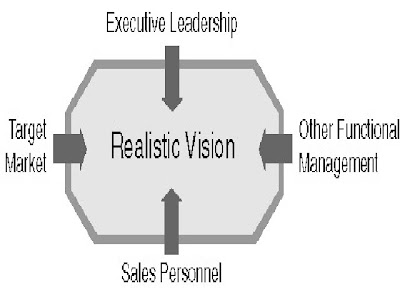
To do this, you will require a team of contributors, as shown in Figure 3-1.
Figure 3-1: Contributions to a realistic vision.
As Lewis Carroll said in Alice in Wonderland, if you don’t care where you are going, you are sure to get there if you walk long enough. Well, maybe in Mr. Carroll’s day, or in Alice’s new world, you could take as long as you needed to get somewhere, but not today! Not in this rapidly changing world of technology-based global business. You just don’t have that much time to reach success, so you’d better start establishing performance objectives and measurements.

Establishing Performance Objectives and Measurements
One thing to keep in mind is that you cannot do it ‘‘the same old way.’’ That would be like trying to drive an old oversized luxury car from the 1950s today. It may be beautiful to look at and comfortable to ride in, but the quality, gas mileage, and shortage of technologies will make it useless for anything but an antique auto exhibit.
There are four areas to consider when creating or setting performance objectives. These are:
Needs of the business
Performance needs
Training needs
Work environment needs
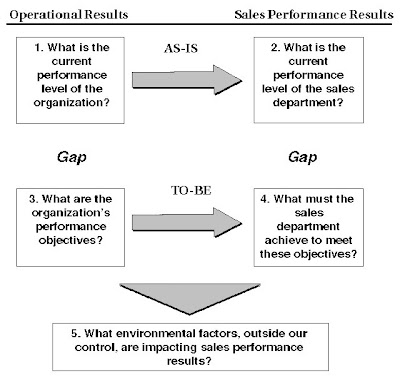
Do you notice the sequence? The order of solutions has usually been found to work best when you follow the above sequence. Remember, the sales department is not an island unto itself. You are performing the sales function to meet some organization-wide need(s), so start with the needs of the business and progress to the needs of the work environment. As you look at any desired performance objective, construct a process improvement analysis that looks like the one in Figure 3-2.

Figure 3-2: Linking performance to gap closure.
Step 1: What Is the Current Performance Level of the Organization?
How are its measurements compared to where they should be right now? How is your overall organization performing against its stated objectives and goals? If you aren’t sure, sit down with the leadership and find out.
What is the current sales organization’s contribution to the organization’s overall current performance? Be honest and explore this subject as you develop your performance improvement plan. Be realistic in a manner that will be relevant to all concerned. Don’t deny or minimize your department’s contribution to a shortfall in goal attainment by the company. At the same time, don’t fall on a sword that is not of your creation. Be honest so that you will be perceived by all as a true member of the organization’s management team.
Step 2: What Is the Current Performance Level of the Sales Department?
Identification of current performance and organizational obstacles. Now that you know what performance levels you need to have as a sales organization, take a look at where you are now. Don’t generalize with such concepts as ‘‘we aren’t very good’’ or ‘‘we don’t make enough sales.’’ Be specific. In what performance areas are you currently lacking, and by exactly how many sales are you falling short? This analysis will give you a starting point to measure success in the coming months and years.
Also, be realistic about organizational obstacles that might make it difficult to improve. Just because these challenges exist, however, does not mean you can treat them as excuses. If it were that easy, anybody could do your job. You are being paid to mitigate or find a way around the obstacles.
Relative importance of all performance results. As you look at the current performance results, identify and categorize them enough to be able to prioritize or rank them in their importance for meeting the desired performance requirements demanded by your answers to Step 1. Everyone is limited by time, money, tools, and people. Make sure that you are working on the performance standards that will have the greatest impact on the successful achievement of your goals. This works for you in two ways. First, it helps keep the entire organization supporting your plans. Second, it keeps your sales team engaged since the performance improvement that you require of them is directly linked to organizational success and is not perceived as just busy work.
Current skills to perform as required. Ask yourself specifically, what are the current skills of the sales team members (or those currently performing the sales function) in areas that have an impact on the highest priorities identified in the last question? If you have a sales team now, analyze each of them individually, not as a team. This will allow you to develop a performance improvement plan for each, rather than grouping them all together in an ill-defined initiative.
Obstacles to performance. Make sure you consider any current obstacles that need to be addressed to reach your, and the organization’s, goals. Be realistic since some of them, such as current compensation models, HR-controlled benefits programs, inadequate product portfolio, insufficient supportive technology, available talent pool, decline in addressable markets, might affect your success.
Skill gaps. This point is very important. Based on your analysis of what is needed to perform at the level required to meet organization or corporate objectives and the current level that the performance is at today, what is the gap? Whether it is per sales person or per the entire team, you now have a starting point, a finish line, and a distance you have to traverse to be successful. This gap will help you set the intermediate goals and milestones of measurement to communicate to the world that you are doing a great job.
Step 3: What Are the Organization’s Performance Objectives?
Identification of internal business goals and challenges. As we said in the previous chapters, a sales manager must always be focused on the organization’s goals, objectives, and challenges. Make sure you have a very clear understanding of the vision for the future held by the leadership of your business, association, or organization. Don’t make assumptions, have preconceived ideas, or jump to conclusions based on partial data. Sit down with your leaders and ask them specifically what performance level would they like to see the organization achieving. Not just the sales team, but the entire organization. Make sure that they discuss their views of what obstacles or challenges might lie in the way.
Identification of customer goals and challenges. Additionally, review your S.W.O.T. on the customer segment you are targeting. Consider the goals and challenges of your most important customers. More than a few successful sales managers have engaged their targeted market in the performance-setting process for their sales team.
Understanding the implications of performance as viewed by both functional management and the customer. The next action for Step 3 is to explore the way your organization’s management team perceives the contribution that the sales organization can make to achieve the overall organizational objective. This is critical! You must understand their view of the role of sales. It might surprise you.
Step 4: What Must the Sales Department Achieve to Meet These Objectives?
Identification of required performance results. Now, find out your required contribution to the organization’s overall goal attainment. You can’t bear the whole burden on your shoulders, but as the initiating department for new orders, you do share a significant portion of the burden for organizational success. Be realistic about what sales performance levels are required of your team and don’t get bogged down in the ‘‘we can’t do that’’ mode of thinking. You can do just about anything if you address realities in your planning. Link your team’s contribution to some form of performance evaluation that is clear, concise, and measurable. Clear means that any reader will be able to understand it. Concise means it is to the point without bombastic wordage. Measurable means you are able to determine the impact. It might be a specific increase in gross margins on the average sale. Or it might be an increase in cost reduction through an increase in order entry quality as measured by returned orders. It could be issues related to customer retention as measured by lost customer rate. It might even be a reduction in internal conflicts between the sales department and other organizational departments as measured by cross-organizational surveys. Remember, if you can’t measure it, it doesn’t belong in the performance standards.
Identification of customer’s required performance model. Spend some time with your most important customers, those you can’t afford to lose, and find out what they require in a sales professional that provides solutions to their business challenges. Make sure you focus on the field and hierarchal level you are selling into, such as IT management or enterprise-wide directorships, so the data will be clear about the point of interaction.
Identification of senior management’s required performance model. Here we are analyzing, in partnership with our senior management, the requirements for a sales performance model. In other words, we understand from previous questions how they perceive the sales department in regard to its contribution to overall organizational success. But what departmental design or model do they require? In some organizations, the senior management or leadership demands accessibility to the sales team with some form of ability to influence daily activities. In other organizations, senior management prefers that the sales team be part of the marketing department or customer service. In others, you might have complete autonomy and independence. You can’t simply shape a perfect sales model and establish performance objectives without senior management’s input on a required or desired departmental model.
Agreement with sales personnel for skills development actions. Whether they are new kids out of the gate or old seasoned veterans, you now have the basis for communicating to your sales personnel a plan for improving the skills that are necessary to meet organization goals and objectives, as outlined in individual performance improvement plans. You will get a greater acceptance of the plan and an agreement by your team to being measured by the new standards of performance because they are directly linked to the goals of the organization as a whole.
Agreement with senior management for skills development actions. To ensure the support and confidence of your senior management team, as well as cross-organizational support, gain the agreement of your leadership to your specific plan of action to improve performance results. As you might be aware, leaders do not like surprises, and if they encounter any, you surely don’t want them to come from your sales plan.
Step 5: What Environmental Factors Outside Your Control Are Impacting Performance Results? What is the current state of your organization? As you step back and look at your company or association, what are the realities? I have been called in many times to work with companies that are in decline because of a lack of interest by the ownership or a disappearing target market. I’ve also been called in to situations where the global companies are challenged to communicate effectively in diverse cultures, where there is a demand for different approaches to success in localized markets. I don’t mean that we just give up in these situations, but we must incorporate them into a plan that accounts for any realities we need to work around and through if we want to attain success.
What is the current state of the business drivers we talked about in Chapters 1 and 2? Remember the business drivers? The current, trending, and future of each must be incorporated in your sales plan if it is to have any validity.
Technology (hardware and/or software)
Globalization
Competition
Customers
Demographics
Lifestyles
Psychographics (consumer sentiment)
Firmographics (business sentiment)
Economy
Regulatory practices
Business practices
Be honest and explore each of the previous questions as you develop your performance improvement plans, and as you do, ask yourself the following questions:
How good is your business intent? Is it in complete alignment with all realities?
What are the key business drivers mentioned previously that will have the greatest impact on success?
What do you know about the internal environment? Do you need to know more, and where will you go to get that information?
What do you know about the external environment? Do you need to know more, and where will you go to get that information?
Raising the Bar for Existing Sales Team Members
As you set performance standards for your team members, you must establish ones that will drive a higher and higher level of performance from your existing sales personnel. As I mentioned previously, you cannot do this as a group, but rather from the unique individuality of each person. No matter what you are creating as a new expectation, each person will be starting from a different point in his or her control and understanding of the performance skill set.
Measure where your team members are, where you want them to be, how much time is available to improve their performance skills, and what their rate of learning is. Also, develop a performance improvement plan that is based on where you want them to be both in the short term and twelve months from now.
The one key to performance improvement for existing team members is that they must recognize and understand the relevance of the performance standard to the business environment. If they don’t, they will be hesitant and resistant.

Using the New Performance Standards to Hire
It can be much easier to set standards for the new hires. Add any required performance skills to a list you will be creating in the next chapter. It will make hiring much easier since you can now specifically measure all possible candidates, both internal and external, against a valuable competencies scale.
But, remember, you cannot have a performance standard for new hires that is different from the one for existing team members. This will only lead to dissatisfaction and complications in the compensation program, as well as possible legal problems for you and the company. Make sure that you are being fair to all team members.

Chapter Summary
In this chapter we discussed the need for establishing clear, reasonable performance measurements for each and every team member. Rather then being constructed arbitrarily, this is done by linking the approach to internal and external factors, gap analysis, and the overall organizational business plan. The resulting performance analysis can be used both to raise the bar for existing team members and to set equally high standards for new hires.

الأعـمـال بسرعة الخاطرة الباب الأول تدفق المعلومات هو قوام حياتك الفصل الأول الإدارة بقوة الحقائق

قوام سداد الحكم في مجال الأعمال هو العثور على الحقائق والأحوال الخاصة بالتقنية والسوق، وما شابهها، والتعرف عليها في صورها المتغيرة باستمرار. إن سرعة التغيير التقني الحديث يجعل البحث عن الحقائق سمة ضرورية على الدوام.
الفريد ب. سلون:
" سنواتي مع جنرال موتورز"
ليّ معتقد بسيط لكنه قوي وهو أن الطريقة الأجدى لتمييز شركتك عن منافسيك، الطريقة الأفضل لوضع مسافة بينك وبين المتزاحمين، هو أن تفعل بالمعلومات شيئاً ممبزاً. إن الكيفية التي بها تَجمع المعلومات وتعللجها وتستعملها سوف تحدد ما إذا كنت من الفائزين أم الخاسرين. هناك الكثير من المنافسين. هناك الكثير من المعلومات المتاحة عنهم وعن السوق.. والذي هو الآن عالمي. سيكون الفائزون هم أولئك الذين يطورون نظاماً عصبياً رقمياً عالمياً يتيح للمعلومات أن تتدفق بسهولة خلال شركاتهم من أجل التعلم الأمثل والدائم.
كأني بك ترد: كلا، بل إن الفيصل هو العمليات الكفؤة! هو الجودة! هو شهرة الصنف والسعى وراء الحصة السوقية! هو الاقتراب من العملاء! بالطبع يعتمد النجاح على كل هذه الأشياء؛ فما من أحد يستطيع مساعدتك
إذا كانت عملياتك متعثرة .. إذا لم تكن يقظاً بشأن النوعية .. إذا لم تعمل جاهداً لتوطيد صنفك .. إذا كانت خدمتك للعملاء دون المستوى. إن الاستراتيجية السيئة ستفشل مهما كانت جودة معلوماتك، كما أن التنفيذ الأعرج يحبط الاستراتيجية الجيدة. إنك إذا أسأت أداء ما يكفي من الأشياء فسيكون مآلك الخروج من ساحة الأعمال.
ولكن مهما كان ما تتمنع به اليوم ـ موظفين حاذقين، منتجات ممتازة، رضا العملاء، سيولة نقدية في المصرف ـ فإنك تحتاج إلى تدفق سريع من المعلومات الجيدة لتسليس العمليات والارتقاء بالنوعبة وتحسين تنفيذ الأعمال. معظم الشركات لديها أناس جيدون يعملون لها ومعظم الشركات تريد فعل ما يرضى عملائها. ثمة بيانات مجدية موجودة في مكان ما داخل أغلب المؤسسات. إن تدفق المعلومات هو قِوام حياة شركتك لأنه يساعدك على استخلاص أفضل ما لدى عامليك والتعلم من عملاءك. انظر إذا كانت لديك المعلومات اللازمة للإجابة على هذه الأسئلة:
l ما رأي عملاءك في منتجاتك؟ ما هي المشاكل التي يطالبونك بحلها؟ وما هي السمات الجديدة التي يطالبونك بإضافتها؟
l ما هي المشاكل التي يلاقيها موزعوك وبائعوك أثناء بيع منتجاتك أو أثناء عملهم معك؟
l أين يكسب منافسوك أعمالاً منك، ولماذا؟
l هل متطلبات العملاءالمتغيرة تدفعك إلى تطوير مقدرات جديدة؟
l ماهي الأسواق الجديدة الناشئة التي ينبغي لك أن تدخلها؟
لن يضمن لك جهاز عصبي رقمي الإجابات المناسبة على هذه الأسئلة وإنما سيخلصك من أطنان من العمليات الورقية القديمة حتى يكون لديك الوقت أمام ناظريك كى تتمكن من رؤية الاتجاهات وهى مقبلة عليك. من شأن جهاز عصبي رقمي أيضاً أن يجعل من الممكن ظهور الحقائق والأفكار سريعاً من أسفل في مؤسستك.. من اؤلئك الذين لديهم معلومات عن هذه الأسئلة ـ وربما العديد من الأجوبة. والأهم من هذا وذلك هو أنه سيساعدك في القيام بكل هذه الأشياء على جناح السرعة.
إلإجابة على الأسئلة الصعبة
تقول نكتة قديمة في مجال الأعمال إن السكك الحديدية لو أدركت أنها تنتمي إلى مجال النقل وليس إلى مجال قضبان الصلب لكنا الآن طائرين على متن خطوط "يونيون باسيفيك" الجوية. هناك منشآت عمل عديدة قامت بتوسيع مهامها أو تغييرها بطرق أشد جوهرية من هذه؛ فصانعة غير موفقة لأول مطهاة أرز كهربائية في اليابان تتطورت للتصبح شركة سوني، إحدى متصدرات العالم في الإلكترونيات الاستهلاكية والتجارية وفي صناعتى الموسيقى والأفلام. وثمة شركة بدأت بصنع آلات لحام وأجهزة استشعار ممرات البولينغ وآلات تخفيض الوزن ثم انتقلت إلى مرسمات التذبذب والحواسيب لتصبح ما نعرفه اليوم بـ"هويليت باكارد". لقد تتبعت هذه الشركات السوق فأحرزت نجاحاً خارقاًً، ولكن معظم الشركات لا تستطيع فعل ذلك.
بل حتى لو نظرت إلى مجال عملك الحالي فليس من الواضح دائماً أين تكون فرصة النمو التالية. تتمتع شركة ماكدونالز في عالم الوجبات السريعة المضطرب بأقوى اسم صنف وأكبر حصة سوقية وسمعة طيبة من ناحية النوعية، ولكن أحد محللي السوق اقترح مؤخراً أن تبدّل ماكدونالدز نمط عملها؛ فقال مشيراً إلى اهتمام الشركة أحيانا بانتاج دُمى مستوحاة من الأفلام السينمائية إن على ماكدونالدز أن تسنخدم سندوتشات الهامبيرجر ذات الهامش المنخفض لتبيع خطاً من دمى ذات هامش مرتفع عوضاً عن االقيام بالعكس. ومع أن تغييراً كهذا أمر مستبعد لكنه ليس مما لا يمكن التفكير فيه في عالم الأعمال الراهن المتغير سريعاً.
العبرة المهمة هنا هى الأ تأخذ شركة موضعها في السوق كأمر مسلم به، بل عليها أن تعيد التقييم باستمرار. فرب شركة ستحقق فتحاً مبيناً في مجال آخر من مجالات الأعمال ورب أخرى ستجد أنها ينبغي أن تلزم ما تجيد معرفته والقيام به. والشيء الأهم هو أن تكون لدى مدراء الشركة المعلومات اللازمة لفهم مزيتهم التنافسية وماهية سوقهم الكبير التالي.
سوف يساعدك هذا الكتاب على استعمال تقنية المعلومات لتوجيه الأسئلة الصعبة وكذلك للإجابة عليها بشأن ماذا ينبغي أن تكون أعمالك وأين ينبغي لها أن تذهب. تتيح لك تقنية المعلومات الحصول على البيانات التي تؤدي إلى الفهم النافذ لأعمالك. إنها تمكّنك من التصرف بسرعة، وتتيح حلولاً لمشاكل العمل لم تكن ببساطة متوفرة من قبل. إن تقنية المعلومات والأعمال تصبحان الآن مترابطين ترابطاً لا فكاك منه. ولا أعتقد أن أي شخص يمكن أن يتحدث حديثاً ذا معنى عن أحدهما بدون أن يتحدث عن الآخر.
اتخاذ نهج موضوعي قائم على الحقائق
الخطوة الأولى في الإجابة على أي سؤال صعب متعلق بالأعمال هى اتخاذ نهج موضوعي قائم على الحقائق. هذا المبدأ، الأسهل قولاً عن العمل به، موضح في كتاب الأعمال الذي أفضله: "سنواتي مع جنرال موتورز" لألفريد ب. سلون، الابن. إذا كنت تقرأ كتاباً واحداً عن الأعمال فعليك بكتاب سلون (ولكن لا تترك هذا الذي في يدك لتفعل ذلك). إن من الملهم أن يرى المرء في رواية سلون عن حياته العملية كيف أن القيادة الإيجابية الرشيدة المركزة على المعلومات يمكن أن تقود إلى نجاح ساحق.
أثناء فترة إدارة سلون التي امتدت من 1923 إلى 1956 أصبحت جنرال موتورز إحدى أوائل مؤسسات الأعمال المعقدة حقاً في الولايات المتحدة. لقد فهم سلون أن أى شركة لا يمكنها تطوير استراتيجية كاسحة أو الاضطلاع بمشروعات مناسبة دون أن تبني على حقائق ورؤى من الأشخاص في المؤسسة. وقد طوّر فهمه الخاص به للأعمال من تعاونه الشخصي اللصيق مع الفنيين واختصاصي الأعمال من معاونيه وبزياراته الشخصية المنتظمة لمرافق الشركة الفنية، غير أن تأثيره االأكبر كمدير جاء من الطريقة التي أقام بها علاقات عمل مع موزعي جنرال موتورز على امتداد القطر؛ فقد دأب على جمع معلومات من موزعي جنرال موتورز وأنشأ معهم علاقات وثيقة مثمرة.
استفاد سلون كثيراً من رحلات لتقصي الحقائق. لقد أعد ّعربة خصوصية من عربات السكة الحديد كمكتب له وجاب كل أرجاء البلاد زائراً موزعي الشركة، وكان في الغالب يلتقي ما بين خمسة وعشرة منهم يومياً. كان يريد أن يعرف ليس فقط ما تبيعه جنرال موتورز للموزعين بل وما يباع من الحصص المخصصة لهم. وقد ساعدت هذه الزيارات سلون على أن يدرك في أواخر العشرينيات أن الأعمال في مجال السيارات آخذة في التغيير؛ فالسيارات المستعملة باتت الآن وسيلة المواصلات الأساسية، وبات المشترون من ذوي الدخل المتوسط يبتاعون سيارات جديدة أفخر بفضل نظم البيع بالتقسيط والمقايضة الجزئية [شراء سيارات جديدة بقديمة مع دفع الفرق]. أدرك سلون أن هذا التغيير يعني أن لب علاقة جنرال موتورز بالموزعيين يجب أن يتغير أيضاً بانتقال الأعمال في مجال السيارات من مسألة بيع إلى متاجرة. لقد بات على الصانع والموزع تطوير علاقة أشبه بالشراكة. قام سلون بإنشاء مجلس موزعين يتقابل بانتظام مع كبار تنفيذيي جنرال موتورز بمقر الشركة، كما أنشأ هيئة لشؤون الموزعين تتولى شكاوى المزعين وأجرى دراسات اقتصادية لتحديد أفضل المواقع لإقامة مراكز توزيع جديدة، بل إنه ذهب إلى أبعد من ذلك بإرساء سياسة مفادها المجازفة بتمويل أكفاء الرجال ممن لم يكن لديهم رأس مال جاهز لإنشاء مراكز توزيع.
بيد أن المعلومات الدقيقة بشأن المبيعات ظلت عسيرة المنال؛ فقد كانت أرقام مبيعات جنزال موتورز غير متسقة وغير مستحدثة وناقصة. كتب سلون: "عندما كان الموقف الربحي للموزع يعتل لم يكن أمامنا سبيل لمعرفة ما إذا كان ذلك بسبب مشكلة سيارة جديدة أم مشكلة سيارة مستعملة أم مشكلة خدمة أم مشكلة قطع غيار أم مشكلة أخرى. وبدون حقائق كهذه كان من المستحيل وضع أي سياسة توزيع سليمة موضع التنفيذ." قال سلون إنه كان على استعداد لأن يدفع "مبلغاً ضخماً" ويحس بأنه "محق تماماً في ذلك" إذا كان كل موزع "يستطيع معرفة الحقائق المتعلقة بأعماله ويتعامل مع التفاصيل العديدة… بطريقة ذكية". كان سلون يعتقد أن مساعدة الموزعين في مسائل المعلومات هذه "سيكون أفضل استثمار قامت به جنرال موتورز إطلاقاً".
من أجل مواجهة هذه الإحتياجات وضع سلون نظاماً قياسياً للمحاسبة على نطاق جنرال موتورز وكل مراكز توزيعها. والكلمة المهمة هنا هي كلمة "قياسي"؛ فكل موزع وكل مستدخَم على كل مستوى في الشركة كان يصنِّف الأرقام بنفس الطريقة تماماً. وبحلول منتصف الثلاثينيات بات بوسع موزعي جنرال موتورز وأقسامها الخاصة بالسيارات ومكاتبها الرئيسية اأن تقوم جميعاً بتحليل مالي مفصَّل باستعمال نفس الأرقام. فمثلاً كان باستطاعة مركز للتوزيع أن يقيس ليس فقط أداءه هو بل أداءه إزاء متوسطات المجموعات الأخرى.
لقد كان من شأن بنية تحتية أتاحت معلومات دقيقة أن أدت إلى مؤسسة متجاوبة لم تستطع الشركات الأخرى لصناعة السيارات أن تدانيها مثيلاً لعقود من الزمان. ساهمت تلك البنية التحتية، التي أسميها "جهاز الشركة العصبي"، في هيمنة جنرال موتورز على صناعة السيارات طوال حياة سلون المهنية. ولم تكن حينذاك رقمية بعدُ إلا أنها كانت ثمينة للغاية. كانت معرفة مخزون الموزع أمراً تجيده جنرال موتورز أكثر من غيرها، وقد نالت جنرال موتورز مزية تنافسية هائلة من استغلال تلك المعلومات. وتجاوزت هذه الاستفادة من المعلومات جدران جنرال موتورز؛ فقد استعملت جنرال موتورز نظم معلومات كُتيبية لبناء أول "اكسترانيت"ـ شبكة تربط الشركة بمورديها وموزعيها.
بالطبع لم يكن في إمكانك الحصول على معلومات تتدفق خلال شركتك آنذاك بمثل الكم الذي يمكنك الحصول عليه الآن؛ فالأمر كان سيقتضي مكالمات هاتفية جد كثيرة وأناساً جد كثيرين يتناقلون أوراقاً وينكبون على سجلات ورقية محاولين الربط بين البيانات والعثور على الأنماط. كان ذلك سيكلف باهظاً. وإذا أردتَ اليوم إدارة شركة ذات مستوى عالمي فعليك أن تذهب إلى أبعد من ذلك بكثير وتنجز بأسرع من ذلك بكثير. إن الإدارة بقوة الحقائق ـ والتي هو أحد أساسيات الأعمال لدى سلون ـ تتطلب تقنية المعلومات. لقد تغير تغييراً درامياً ما تطيق الشركات القيام به وما ترى أنه يستحق القيام به وما بمقدورها تنافسياً القيام به.
تستعمل جنرال موتورز الآن تقنية الحاسوب الشخصي ومقاييس الإنترنت للاتصال بعملائها؛ فحلها المتمثل في منظومتها المسماة "جي ام أكسس" يستعمل شبكة للشركة واسعة النطاق تستخدم الأقمار الصناعية للتعامل بين مقر الشركة ومصانعها وموزعيها البالغ عددهم 9000، والذين لديهم أجهزة متصلةعلى الخط الإلكتروني ((online لأغراض الإدارة المالية والتخطيط التشغيلي بما في ذلك إدارة الطلبات الإجمالية وتحليل المبيعات والتنبؤ بها. وتقوم أداة بيع تفاعلية بالجمع بين سمات المنتجات ومواصفاتها وتسعيرها وغيرها من المعلومات. ويحظى فنيو خدمة المنتجات بوصول فوري إلى أحدث المعلومات عن المنتجات وقطع الغيار من خلال كتيبات الخدمة الإلكترونية والنشرات الفنية وتخطيط قطع الغيار وإعداد تقارير المخزون على الخط الحاسوبي. يربط البريد الإلكتروني الموزعين بمقر جنرال موتورز ومصنعها وببعضهم بعضاً. يتم دمج الحل الذي يأتي به الموزع الخاص في موقع جنرال موتورز العام على الإنترنت حيث يجد العملاء معلومات تفصيلية عن السيارات. توفر تقنيات الإنترنت الأساس لتحول جوهري في الطريقة التي بها يتسوّق المستهلكون السيارات، فلا غرو أنهم يضعون جنرال موتورز كهدف للتجارة الإلكترونية. وبالطبع عمدت شركات صناعة السيارات الأخرى كذلك إلى تحسين أنظمة معلوماتها؛ فتويوتا تحديداً استخدمت تقنية المعلومات لتطوير انتاج صناعي على مستوى عالمي.
تمييز شركتك في عصر المعلومات
إذا كانت إدارة المعلومات واستجابة المؤسسة قد أحدثتا مثل هذا الاختلاف في صناعة تقليدية من ذات المداخن قبل سبعين سنة فأي تمييز أكثر ستُحدثانه مدفوعتين بالتقنية؟ قد يكون لأي شركة حديثة لصناعة السيارات اسم تجاري قوي وسمعة لنوعية جيدة في يومنا هذا ولكنها تواجه منافسة أكبر فأكبر على امتداد العالم. إن كل شركات صناعة السيارات تستعمل نفس الصلب ولها نفس آلات الثقب وتقريباً طرق انتاج متماثلة كما أن لها نفس تكاليف النقل. تقوم الشركات الصانعة للسيارات بتمييز أنفسها عن غيرها بمجموع من العوامل تتمثل في مدى جودة تصميمها لمنتجاتها ومدى ذكائها في استغلال التذية المرتدة من العملاء لتحسين منتجاتها وخدماتها ومدى سرعتها في تحسين عملياتها الانتاجية ومدى مهارتها في تسويق منتجاتها ومدى كفاءتها في التوزيع وفي إدارة مخزوناتها.. وكل هذه العمليات الغنية بالمعلومات تستفيد من العمليات الرقمية.
تتجلى قيمة النهج الرقمي بصفة خاصة في الأعمال المتركزة حول المعلومات مثل المصارف وشركات التأمين؛ ففي مجال المصارف نجد أن البيانات الخاصة بعلاقات العملاء وتحليل الاعتمادات هي في قلب العمل المصرفي وقد ظلت المصارف دائماً أكبر مستخدمي تقنية المعلومات في عصر الإنترنت، ولكن في عصر الإنترنت والتحرير المتزايد للأسواق المالية

الاثنين، 17 يناير 2011

The Secrets of Great Sales Management: Advanced Strategies for Maximizing Performance

Chapter 2: Planning For Today and Tomorrow
Overview
First say to yourself what you would be; and then do what you have to do. —EPICTETUS Discourses, Book 3, Chapter 23
Without a plan, you are left with only a vague concept of past tactics, a desire to do better, and uneasiness about your ability to succeed. Lacking a plan, you have no definable goals or objectives, no means of evaluating progress, and no ability to measure your advancements against your team’s potential or against those with whom you are competing.
The Value of Planning
Imagine an Olympic sailor positioning the sailboat in the water wherever she or he feels like it. Continue to imagine the sailor dashing off in any old direction, regardless of the starting time, position, buoy placement, crosswinds or currents, or even where the finish line might be found. This mess could, and probably would, result in very little likelihood of winning. Truth be told, a competitor like this might not even be asked back to compete in future races. Ask yourself: Do you wish to compete in future races?
A sales manager’s primary function is to collect all available information, determine the relative value of the data, and then develop and deploy a well-thought-out plan for achieving the results that will best support the organizational or corporate goal(s). With well-thought-out plans, you will be able to count on internal support, external supplier and partner support, management support, cross-organizational support, sales team support, and even the support of your key customers or target markets
A Snapshot of Today
One of the greatest challenges for a sales manager to overcome is the temptation to construct plans based solely on egocentric ambition or antiquated historical data. Yes, it is true that if you are unaware of history’s mistakes, you are doomed to repeat them. But it is even more important to understand the current changes or trends unfolding across the venue in which you are striving to succeed. The starting point is to construct a clear image of ‘‘today.’’ Later you will put these images into motion through trend analysis, but for now, let’s just think about the current environment. There are several contributing perspectives you could review, but let’s focus on the following:
Technology (Hardware and/or Software). The accelerating evolution of technology is placing a great deal of stress on business planning for two reasons. First, technology is expensive, so it’s of great concern to all as to how long any selected generation of technology will be applicable before it becomes out of date. Second, an effective planner attempts to predict future directions, but that’s amazingly difficult to do when one tries to picture a technology that hasn’t been invented yet and lacks standards that will align the field of potential providers. One only has to think about the history of Beta versus VHS, the current battles over wireless and voice recognition models, or (perhaps) the coming standards setting requirements of quantum computing, hologram imaging, and implanted proximity biochips to understand why decision makers are so concerned.
Globalization. The world is not actually getting smaller, but it sure seems that way. Just turn your laptop computer over and look at all the countries that have contributed to its design, construction, and approval. The natural contributors that come to mind might include China, Japan, or Taiwan. But take a closer look. In addition to those countries, you might be surprised to see Turkey, Malaysia, Singapore, Israel, Argentina, Croatia, India, Cyprus, Lithuania, Latvia, the Philippines, or Slovenia. We have practiced international trade for thousands of years, but it has taken technology to allow a true, real-time global economy to function. That presents two challenges for the sales manager/planner. First, you must now prepare to compete against new global players who come into your home market, often from a well-protected home market of their own that gives them some economic advantage. This is challenging in that you often do not know enough about them to create an effective counter-competitive strategy. Second, your own domestic customers are going global, and they expect you to support them, in some manner, around the world. Going global may sound exciting, but be careful what you wish for—you just might get it. Going global can be a lot more challenging than most organizations believe.
Competition. In the past, you probably knew a great deal about the competition because your competitors lived in the same ‘‘neighborhood’’ as you did. In those smaller, geographically contiguous markets, our rivals often looked, walked, and talked like you. But that has all changed as the result of the growth of technology and globalization. You now find yourselves competing against virtual rivals that pop up out of nowhere and present an impressive face, via a Web site, to the customers you had thought were your most protected. Your virtual rivals may look as big as IBM, but are actually just three people working out of a garage in Brazil. Thanks to the Internet and FedEx, they can provide offerings to customers anywhere in the world overnight—just like us (maybe)!
So what do you know about them? Are they partially owned by a foreign government or considered a protected national treasure, making it very hard, in either case, to collect competitive information about them? How important is their competing product to their overall business? How do they view themselves, and how do they make decisions? What is their competing cost? Their structure and distribution model? How do they view us? To put it in terms you’ve already discussed, what’s their S.W.O.T.?
Customers. About 100 years ago, Henry Ford deployed the concept of mass production. I’m sure he wasn’t really the first, but he certainly got credit for it in the new industrial age that was blossoming at the time. Up until Mr. Ford’s time, automobiles were the playthings of the rich, who were the only ones who could afford them. In being able to apply the golden age of manufacturing to the benefit of the average consumer, Ford and his peers required absolute consistency in processes to deliver the exciting new offerings at a reasonable price. He best exemplified the need by stating that buyers could have any color Ford they wanted as long as it was black. He was in control!
As America grew, and changed, people like Henry Ford found it harder and harder to control the requirements of a consumer who was moving out of the cities and into the pasture lands—better known as the suburbs. Intermediaries were needed to cover this broader, more distributed marketplace. Ford deployed dealers. Others chose to sell through retailers, wholesalers, and distributors. Subtly, the power shifted in the supply chain from the manufacturers to the retailers. Consumers began to care more about where they bought it than about who manufactured it. They wanted convenience in purchasing, and outlets like Sears, Graybar, and, later, Home Depot gained the upper hand. As soon as these intermediaries recognized their new power, they demanded that the manufacturers design and create the products the way they wanted to sell them or they would go to a no-name producer to make them the way they wanted. Americans moved away from mass production and toward mass customization. They even went so far as to demand their own branded labels on products produced by others (e.g., Albert-sons private labels, Gap, and CVS).
Over the last decade, though, the shift has occurred again. Now, thanks to technology and globalization, consumers are no longer bound by the offerings of outlets within their geographic area. If prospective buyers don’t see their pet’s favorite rice and lamb stew at a local pet-food store, they can go online and find someone in the world who does have what they want. And, thanks again to overnight shipping, they can have it in their homes or offices the next day. With this new-found power, consumers are telling the world they no longer want to be treated like everyone else; they want to be sold to in a manner that is unique to them. Not like their relatives and not like their neighbors. They are now demanding that they be treated as a market of one. The problem for a planner is to understand how that market of one views value and how it goes about making purchase decisions.
Demographics. It is nearly impossible for a business to integrate the advantages of mass production, the variations of mass customization, and the diversity of markets of one into a competitive sales strategy. Somehow you have to find enough markets of one, even if they are not contiguously located, to take advantage of state-of-the-art production techniques. The problem is that old models of market demographics are based on mass customization models and can’t account for the diversity within a group or category. For example, the fastest growing demographic group (and largest minority) in the United States is a grouping entitled ‘‘Hispanic.’’ In the past, businesses produced Hispanic-oriented advertising to cover this targeted market. But ask yourself about the similarities and differences among Hispanics born and raised in Tucson, those born and raised in Miami, and those born and raised in Brooklyn. The differences between them need to be explored as much as their similarities. In addition to cultures, you must consider gender, age, education, hobbies, interests, professions, and so much more.
What do you really know about your customers? How do they make decisions? What knowledge must they have to make a decision in your favor? Values, belief systems, and judgment paradigms are not the exclusive realm of the end consumer; they are well entrenched in corporate offices, too.
Lifestyles. Once you decide what your perfect customers look like, you need to recognize the changes that are going on in lifestyles, not just in the United States, but around the world. Of course, people are more mobile and distributed. That reality may have already sunk in as you manage a virtual home office salesperson in another time zone. But think about this lifestyle change: people are living longer. The question that presents itself to us is, what part of life are you extending? Certainly not childhood or adolescence or even early adulthood. Old age has certainly been extended, but there seems to be another focus these days. When I was a child, you retired at age 65 because you were burnt out. By 70, you were in a retirement or convalescent home because you could no longer care for yourself. Not very good golden years, were they? One of the greatest changes in lifestyles these days is the expansion of the upper-middle-age bracket. How many sixty-five- or seventy-year-olds do you still find actively contributing to an organization or even starting their own new business? A whole lot of them! But if that is the current trend, how will it impact your sales plan? Also a whole lot!
Psychographics (Consumer Sentiment). There are a lot of variations around this terminology, but I like to consider it the mood of the consumer. How consumers feel about ‘‘things’’ is extremely important to the supply chain. If they aren’t happy, in most cases they aren’t spending money. Some experts contend that there are only two groups that are not affected by the end consumer—the military and the government. I believe that those two groups are also affected because politicians know consumers vote with their emotional feelings about issues they perceive as affecting them, so they had better manage spending in line with the majority of consumer expectations.
Firmographics (Business Sentiment). Another trend to consider is that of the mood of business, or more correctly, of the business leadership. Often times, this mood is out of alignment with the mood of the consumer mentioned previously. For example, when the economic bubble began to burst toward the end of the twentieth century, consumers thought it was a momentary snag and kept on spending. Business leaders—at least the intelligent ones—knew immediately that they were in trouble. They had built an organizational or corporate infrastructure designed to support the needs of the bubble economy. When the bubble burst, businesses were too big and too expensive to run in the lean and mean economy. What followed were layoffs, restructurings, and bankruptcies (in addition to the broken promises made to employees and shareholders). The businesses you sell to or through will not buy or buy more until their sentiment improves and is once again in alignment with consumer sentiment.
Economy. Quick, which economy was better? The bubble economy of the 1990s or the bottomed-out economy of the early 2000s? Not sure? Neither am I. As this book is being written, the current state of the economy is tough. There does seem to be a turnaround on the horizon, but if it comes, it will be slow due to a lack of trust generated from so many false promises by pseudoexperts espousing unethical, forged financial forecasts. The bubble economy might have appeared to be better, but it was doomed to failure because of poor attention to detail, including bad or nonexistent business plans.
As a sales manager, either way you look at it, it is challenging to figure out where the current trend in the economy is going and what it might mean to your strategic sales plans.
Regulatory Practices. No matter what your political leanings are, you seem to be living in an increasingly regulated world. From consumers through manufacturers, every day brings new guidelines, regulations, and standards. To top if off, thanks to globalization, you may find your products, market approach, or personnel being regulated by governments or industry committees from halfway around the world. Just look at the raging controversy over genetically modified foods or the trade barrier wars at the World Trade Organization.
Business Practices. Based on what you have just reviewed, there are a lot of pressures on the marketplace that you are trying to sell into. There are also pressures on the company you work for, your suppliers, your partners, your distributors, your competitors, and your customers. As these pressures, from technological to regulatory, have evolved, businesses have attempted to address the changes with adaptations to the way they practice their profession. You now have such things as laptop and desktop computers, pooled resource networks, personal digital assistants, e-mail, voice mail, wireless links, global pagers and walkie-talkies, tele-conferences, contract employees, and virtual or home offices. The struggle has been to incorporate these new practices into traditional practices. Unfortunately, most businesses have responded to this practice change by relying more on activity-based measurements than on performance measurements.
Scenario and Simulation Planning
Once you have estimated where a contributor to sales success currently is, you must now put that contributor in motion. Certainly snapshots are valuable, but they don’t tell you where the contributor has been or where it is going. Consider psychographics. To say that the mood of the consumer is slightly ‘‘negative’’ about the economy doesn’t help much. Only by looking at previous data and trending out the changes can you determine whether this current mood is a growing negativity or an improvement in attitude. Once you have a history-to-present trend for any contributor, you can project that trend out into the future. You can also incorporate future alternative events that may have an impact on your plans. There are two excellent, and easy to apply, trend projection techniques that you can use with your sales team. Remember, the more diverse the input, the better the results.
Scenario Planning
This tool is based on the concept that there is more than one possible future. A skilled planner must uncover the most likely scenarios and find the environmental indicators that announce which one seems to be the unfolding future. Start by having your diverse planning team brainstorm current trends and develop a reasonably clear picture of a future business environment about five years out. Next, have the team identify several significant indicators that demonstrate that the environment is truly moving in the imagined direction.
Example
Scenario 1: Five years from now, the business environment will be stronger than today, with very large and very small competitors driving the markets based on control and management of information that support a focus on a ‘‘market-of-one’’ approach.
Indicators for Scenario 1: Sustained improvement of major economic indicators, reduction of medium-size businesses, increase in venture capital funded start-ups, focus on smaller and smaller market segments, increase in data mining and manipulation software, increased electronic customer interface channels based on individual preferences, blurring of the distinction between sales and marketing organizations due to the need for greater ‘‘customer intimacy.’’
Once your team has created a single vision for the future and defined some of the indicators that demonstrate that your future world is truly unfolding, you’ve only completed part of the exercise. You must now place those indicators in logical sequence and create a timeline map for the five-year period.
Don’t relax too soon. You now need to create three to four alternative, yet realistic and attainable, futures. They need to be different from your first ones, and each will have its own set of indicators.
Example
Scenario 2: Five years from now, the business environment will be weaker and more chaotic than today, with major industries moving to offshore locations resulting in loss of intellectual capabilities and technological leadership.
Indicators for Scenario 2: No improvement in the major economic indicators, increasing loss of service industry jobs, increase in global competition, new technology standards being driven and set by countries such as China and India, decline in foreign-born student enrollment in American colleges, and shrinkage of previous industry leaders based in the United States.
The final result is that you can now begin to construct your plans around a trended future, know what indicators to watch for, and be prepared when different events require you to alter your plans.
Simulation Planning
This form of ‘‘future’’ trending is somewhat similar to the scenario process, but it segments out the primary drivers for analysis before combining them for some specific period in the future. Let’s start by taking another look at your eleven identified drivers that impact sales success:
Technology (hardware and/or software)
Globalization
Competition
Customers
Demographics
Lifestyles
Psychographics (consumer sentiment)
Firmographics (business sentiment)
Economy
Regulatory practices
Business practices
Break your planning group into eleven individual teams with each one focusing on only one of the drivers listed above. It is best to select members for a particular team who are subject matter experts in the field. For example, bring some IT folks into your session to concentrate on technology or some government affairs personnel to focus on regulatory practices.
Separate the groups into different planning locations and ask each to determine where their driver has been, where it is currently, and (if the trend continues) where it might most likely be in five years.
Finally, bring the teams back together again and overlay the drivers to create a vision of some specific time in the future. You and your team will be amazed at how clear an image develops. The pace of change is speeding up to the point where the future will not be a bigger, faster, shinier version of today.
Although you are not fortune-tellers, you must try to grasp a view of tomorrow to do better planning today.
Determining Prioritized Corporate Objectives
Many sales managers become so entrapped in their own team’s goals that they forget that the primary objective of a sales department is to help the overall organization meet its goals. You serve a specific purpose: to sell the company’s products or services through strong and effective customer interactions. But you are only one piece of the overall puzzle, and you need to recognize the larger objectives of your organization.
Often sales managers and their sales team members talk about the company only wanting more sales or revenue. In fact, increased sales are often only one component of some larger objectives of the organization. What is your organization’s vision of what would be gained from increased sales? Let’s look at a few examples:
Profitability improvement
Increased shareholder value
Strengthening brand identity
Increased geographic coverage
New market-segment expansion
Deterrent to growing competition
Acquisitions
Increased professionalism
Broadening product or service lines
?What else
Corporate objectives are usually much clearer than you think. Consider developing a few questions you might like to ask your leadership. Here are a few ideas:
What are the greatest opportunities in the organization’s future?
What are the greatest challenges to the organization’s future?
Who is creating long-term strategic plans for the organization? (This can be, and probably is, more than one person.)
What are their stated short- and long-term objectives?
How could their objectives be prioritized?
What do they see as the sales organization’s contribution to these objectives? (Make sure they are as specific as possible.)
Spend time with your senior management and executives to get answers to these questions. Remember, you are looking for answers pertaining to the organization as a whole. It will be your job to narrow the required action down to a sales plan. Approach such a discovery interview just as you did when you were out selling. Listen for the emotions and intent behind the words, not just the words themselves
Clarifying Short-Term, Intermediate, and Long-Term Goals
What you have just discovered are the prioritized goals of your organization as a whole. You have also defined what your team’s contribution to the attainment of these goals might and should be. You must now develop some short-term, intermediate, and long-term goals for your sales team.
Short-term goals are defined as those results that can be achieved in twelve months or less. They are often stated as your team’s sales quotas, but they are also there to support your organization’s yearly objectives, as created and viewed by the leadership, the investors and, of course, the capital markets or capital markets community. They generate immediate cash flow for the company that will, hopefully, exceed expenditures and justify your organization’s approach to contributing to the strategic plan. Short-term goals can usually be achieved with existing resources with only minor modifications to personnel, products, support, or the customer base.Many sales managers find themselves in difficulty because they focus only on longer-term objectives for their team. If you look closely at the first items on the list of your organization’s prioritized goals for the organization as a whole, you will recognize that there are some that must be achieved right away. They may be:
Increased sales revenue
Increased profitability or margin on the average sale
Improved order entry quality to reduce returns
Costs control and/or staff reductions
New product or service acceptance by the targeted market
New geographic expansion
What else? (Must be attainable in under twelve months)
Long-term goals are usually defined as those results that can be achieved only over a longer period of time, say five to seven years. They tend to be linked with the long-term vision of the organization as a whole, and several complex changes and steps must be made to attain these goals. Some of these changes are dramatic and can cause instability to a sales organization. The best way to prevent this is to have clear, concise, and measurable pathways to achieve these long-term goals. They may be:
New market penetration
Strategic sales alliances
Cross-organizational team selling
Complete change of customer’s brand perception
What else? (Must require a period of time to attain)
Intermediate goals are those that fall somewhere between the short- and long-term goals, usually around three years. They could be called milestones because they are often used to sustain support for the long-term goals. Nothing succeeds like success, and these goals are used to persuade senior management and executives that your ideas and reasoning are sound and that significant advances toward your long-term goals are being made. They must link the short- and long-term goals, and they might include such areas as:
Sales competency training curriculums
Sustained sales growth
New electronic connectivity platforms
What else? (Must require a period of time to attain)
Are they S.M.A.R.T. Goals?
Specific,
Measurable,
Attainable,
, andTime Framed
Creating Directional Statements for Your Sales Team
Do you know where you need to take your team in the near and long-term future? If called upon, could you easily and clearly communicate these goals to any and all interested parties? Let’s take a look at some sales management tools to do just that.
Mission and Vision Statements
In essence, you have just constructed the foundation of a mission statement and a vision statement for your sales organization. Surprised that you need them? You may have thought that these directional statements are only for the organization as a whole. The truth is, exceptionally well-run companies have a mission statement and a vision statement for every department. There are two important considerations when constructing directional statements. First, they must be aligned from your sales organization up through the overall corporate statements. Second, they must support the coordinated long-term approach to a vision of success. Let’s take a look at these two powerful statements.
Mission Statement
A mission statement is intended to reach the same audience as the short-term goals. It should influence your senior management and executives, all required immediate support organizations, investors, and the capital markets community. One of the simplest ways of creating a mission statement is to ask the following question:
Being the best you can be, with the resources you currently have available, how would you like your sales team to be described?
Notice that this does not ask for a description of your current sales team. It asks for a description of how the team might appear after you have maximized the potential of your total resources. The answer can be a single paragraph or a sentence with bullet points. Either way, keep it simple and use clear, concise, and measurable terms.
Vision Statement
A vision statement is a directional statement intended to create a motivational environment by giving the personnel a view of the future that they can enthusiastically support. Like a good sales presentation, the vision statement must meet both the wants and the needs of your sales team and all supporting departments. In other words, it must reach the mind and the heart—particularly in this day of fragile corporate– employee relationships.
Although there are many ways to look at this directional statement, a good way to arrive at a vision statement might simply be to ask:
Making changes into the future, how would you like your sales team to be described at some definable future date?
Notice, here we are talking about making changes. Not simply living with what we have or making minor modifications to our current sales team, but making changes. The vision statement has no destination point; it is considered a direction or pathway. You always want to be moving toward a future vision. This must also align well both with the long-term goals of your sales team and with the overall vision for the organization as a whole. Once again, keep it simple and use clear and concise words, not interpretative words. You shouldn’t have to explain or translate it.
Determining Resource Requirements and Availability
You have now completed some key documents involved in successful sales force planning. So far, you have:
Developed a snapshot of the current environment
Applied trend analysis to your snapshot to give you a vision of the future
Determined prioritized corporate objectives
Clarified short-term, intermediate, and long-term goals
Created directional statements for your sales team
Identifying Key Players and Their Motivators
Now you are getting down to the wire in planning documentations. The next step is to realize that you can’t achieve all these wonderful goals by yourself or with only your sales team. You will need internal and external resources, and you will need to ‘‘name names.’’ For example, if you plan to increase customer acceptance of new products or services, you might need the following:
Product management: To change pricing strategy
Advertising: To provide effective push-pull marketing
Finance: To develop some long-term, low-interest financing
Order processing: To expedite orders for this product
Customer service: To handle inquiries and service calls more effectively
But knowing which department to call upon will not lead to goal success. You will need to establish a relationship with key individuals within the department to gain their support. Consider specifically whom you might need now and in the future. This can often be more than one individual or function. For example, you may need an outbound telemarketing representative. But if you borrow this person from his or her current assignment, you’ll be impacting the measurements placed on that person and department by his or her manager. Always spend time getting to know the evaluators of the person or function you need. Remember, when you make even a minor modification, you are altering an entire web of linkages.
After you’ve identified the departments and key players, you need to discover what it is that drives their performance. In most cases, it will be the measurements with which they are evaluated at the end of the year. If you are to gain their total support, you must be willing to support their efforts, too.
Rechecking Prioritized Corporate Objectives
One final planning note. Your organization is always changing. The environment changes, the leadership changes, the customer base changes, the technology changes, and the needs of investors change. As you have seen in the scenario planning discussion earlier, the future may turn out to be very different than you had planned.
Schedule time to regularly recheck your short-term, intermediate, and long-term goals to assure that they are in complete alignment with ever changing business realities. Watch for the indicators that will tell you when a shift in direction is taking place and adjust accordingly. The last thing you want to do is find yourself traveling down the wrong path.
Key Rechecks
Annual reports
Quarterly reports
Press releases
Internal and external speeches by key individuals
Outside evaluators (financial community and auditors)
Changes in organizational mission and vision statements
Your managers
Your leaders
Other department heads
Relevant
Chapter Summary
In this chapter, we talked about the value of planning for both short- and long-term goals. Without a solid plan, you cannot set directions, establish and manage to measurements, or recognize when the situation is changing. Your plan may not always be exactly right, but without it you have nothing with which to benchmark your progress.
You start with giving serious thought to current trends, and then through scenario or simulation planning, project these trends into the future to estimate future requirements.
Equally important is the need to clarify organizational objectives before you set your own sales department goals. Once you have done that, an effective sales manager sets short-term goals to meet immediate needs of the organization, long-term goals to lead to future success, and intermediate goals to measure success. This important direction is often captured in a strong mission and vision statement.
The final step in planning is to determine resource requirements to help you meet your goals: Decide which key players need to be engaged, recognize what their motivation might be to help you be successful, and continually recheck the corporate goals to do the necessary fine-tuning of your plans.

الأحد، 16 يناير 2011

الأعـمـال بسرعة الخاطرة

لجعل تدفق المعلومات الرقمية جزءاً لا يتجزأ من شركتك إليك اثنا عشرة خطوة رئيسية:
للعمل المرتبط بالمعرفة
1-عليك أن تصِّر على تدفق الاتصال خلال المؤسسة عبر البريد الإلكتروني لكى تتمكن من التصرف بناء على الأخبار بسرعة تكاد تكون انعكاسية.
2- ادرس بيانات المبيعات حاسوبياً (online) لإيجاد أنماط وللمشاركة في الرؤى بسهولة. افهم الإتجاهات الكلية واحرص على إضفاء الطابع الشخصي على خدمة كل عميل.
3- استعمل الحواسيب الشخصية لتحليل الأعمال وحوِّل عمال المعرفة إلى العمل ذي التفكير عالي المستوى حول المنتجات والخدمات والربحية.
4- استعمل أدوات رقمية لخلق فرق فعلية تعمل على نطاق كل الإدارات وتستطيع أن تتقاسم المعرفة وتبني على أفكار بعضها الآخر في وقت حقيقي وعلى امتداد العالم. استعمل نظماً رقمية من أجل إرساء تاريخ للشركة يستفيد منه أي شخص.
5- قم بتحويل كل عملية ورقية إلى عملية رقمية مزيلاً بذلك الاختناقات الإدارية ومحرراً عمال المعرفة حتى يتفرغوا لمهام أهم.
لعمليات الشركة
6- استعمل أدوات رقمية للتخلص ن الوظائف أحادية المهام أو لتغييرها إلى وظائف ذات قيمة مضافة تستخدم مهارات عامل المعرفة.
7- اوجد حلقة تغذية مرتدة رقمية لرفع كفاءة العمليات المادية وقم بتحسين المنتجات والخدمات المقدمة. يجب أن يكون كل مستخدَم قادراً على تتبُّع كل القياسات الرئيسية بسهولة.
8- استعمل نظماً رقمية لتوجيه شكاوي العملاء فوراً إلى من باستطاعتهم تحسين منتج أو خدمة.
9- استعمل الاتصالات الرقمية لإعادة تعيين طبيعة أعمالك والحدود المحيطة بأعمالك؛ فكن أكبر وأوفى أو أصغر وأشد خصوصية تبعاً لما يسوغه وضع العميل.
للتجارة:
10- قايِض بالمعلومات الوقت؛ قلل زمن الدورة باستخدام المعاملات الرقمية مع كل الموردين والشركاء وقم بتحويل كل عملية من عمليات الشغل إلى نظام "التسليم في الوقت المناسب".
11- استعمل التسليم الرقمي للمبيعات والخدمة من أجل إبعاد الوسيط عن معاملات العملاء. أما إذا كنت وسيطاً فاستعمل أدوات رقمية لإضافة قيمة إلى المعاملات.
12- استعمل أدوات رقمية لمساعدة العملاء على حل المشاكل بأنفسهم، وإدخر الاتصال الشخصي لأجل الاستجابة إلى احتياجاتهم المعقدة عالية القيمة.
يغطي كل فصل من هذا الكتاب نقطة أو أكثر ـ ومن شأن تدفق جيد للمعلومات أن يساعدك على القيام بعدة أشياء من هذه فوراً. بل إن أحد أهم عناصر أى نظام عصبي رقمي هو ربط هذه الأنظمة المختلفة ـ إدارة المعرفة وعمليات الشغل والتجارة ـ بعضها مع البعض.
تركز عدة أمثلة، لاسيما في مجال عمليات الشغل، على مايكروسوفت. ولذلك سببان أولهما رغبة العملاء في معرفة كيف تستعمل مايكروسوفت ـ باعتبارها من أنصار تقنية المعلومات ـ التقنية في تسيير أعمالها؛ هل تفعل ما تنصح الآخرين به؟ أما السبب الثاني فهو أن بإمكاني الحديث بتعمق عن حكمة تطبيق النظم الرقمية على مشاكل التشغيل التي تواجهها شركتي (مايكروسوفت) فعلاً، وفي الوقت نفسه فقد زرت عشرات الشركات الرائدة للعثور على أفضل الممارسات في كل الصناعات. إنني أريد أن أبيّن قابلية التطبيق الواسعة لنظام عصبي رقمي. ثمة بعض المجالات حيث تجاوزتنا شركات أخرى في التعاون الرقمي.
ستكون الشركات الناجحة في العقود التالية هي تلك التي تستعمل الأدوات الرقمية لإعادة اختراع الطريقة التي تعمل بها. سوف تضع هذه الشركات قراراتها بسرعة وتتصرف بكفاءة وتتصل بعملائها مباشرة بطرق إيجابية. إنني آمل أن تخرج من قراءة هذا الكتاب وقد أثارت اهتمامك إمكانيات التغيير الإيجابي في العشر سنوات القادمة، سوف يضعك التحول إلى النظام الرقمي على الحافة المتقدمة لموجة تغيير مزلزلة ستحطم الطريقة القديمة لمزاولة الأعمال. سوف يتيح لك النظام العصبي الرقمي أن تزاول أعمالك بسرعة الخاطرة، وهذا هو مفتاح النجاح في القرن الحادي والعشرين.

الخميس، 12 أغسطس 2010

طريقة تويوتا


عنوان الكتاب: طريقة تويوتا
المؤلف: جيفري كيه . لايكر .
الناشر: مكتبة جرير
تاريخ النشر: ٢٠٠٩
يقع الكتاب في ٤٢١ صفحة
هذا الكتاب استغرق أكثر من خمسة وعشرين عامًا هي خبرة المؤلف مع شركة تويوتا قام خلالها بدارسة تفاصيل العمل والقيادة الإدارية في هذه الشركة واستخلص عدة مبادئ يقوم عليها العمل في هذه الشركة ورغم أن شركة تويوتا هي شركة عائلية إلا أنها شركة متعلمة وتمتلك ثقافة مؤسساتية يلتزم بها جميع العاملين وفيما يلي ملخص تنفيذي للمبادئ ال ١٤ لأسلوب تويوتا
القسم الأول :فلسفة المدى الطويل المبدأ
المبدأ الأول: أسس قراراتك الإدارية على فلسفة المدى الطويل حتى إن كان ذلك على حساب أهداف المدى القصير المالية

ليكن لديك حس فلسفي تجاه هدف يتجاوز الأهداف قصيرة المدى، ضع جميع عناصر مؤسستك في اتجاه تحقيق هدف مشترك، وهو الهدف الذي يتجاوز مجرد تحقيق الأرباح، استوضح موقعك كمدير في تاريخ الشركة الإداري ،وحاول بعد ذلك أن تنقل مؤسستك إلى المستوى التالي في النجاح، هذه المهمة الفلسفية هي أساس كل المبادئ الأخرى لأسلوب تويوتا .
قم بتقديم القيمة للعملاء والمجتمع والاقتصاد فهذه هي نقطة انطلاقك، وقم بتقييم كل خطوة من خطوات العمل من حيث مدى قدرتها على المشاركة في إنتاج هذه القيمة.
كن مسئو ً لا وجاهد لكي تحقق رؤيتك الخاصة تصرف من خلال الاعتماد على الذات وثق في قدراتك الذاتية تحمل مسؤولية الإدارة وحافظ على مهاراتك التي تساعدك على إنتاج القيمة المضافة، وقم أيضًا بتطوير تلك القدرات .
القسم الثاني :العملية الصحيحة تقود إلى النتائج الصحيحة
المبدأ الثاني :اخلق تدفقًا مستمرًا للعملية بما يكشف الأخطاء الكامنة
.
أعد تصميم عملك والعمليات الداخلية فيه بما يحقق مستوى عاليًا من القيمة المضافة والتدفق المستمر، و حاول أن تتخلص من الوقت الذي يكون فيه العمل بطيئًا أو ينتظر شخصًا ما لكي يقوم بمواصلته.
أخلق التدفق وقم بنقل المواد والمعلومات بأسرع ما يمكن للربط بين العمليات والعمال بما يؤدي إلى تصحيح الأخطاء بشكل فوري.
اجعل مفهوم التدفق واضحًا في ثقافتك المؤسسية، فهذا هو المفتاح الرئيسي لعملية التطوير المستمر الحقيقية ولتطوير الأعمال.
المبدأ الثالث: استخدام نظام "الإنتاج اللحظي" لتجنب الإنتاج الزائد.
ضع عملائك الرئيسيين في العملية الإنتاجية، في الأولوية من خلال العمل على تنفيذ ما يطلبونه وقتما يطلبونه، و بالكمية التي يطلبونها .كذلك لا تقم بتجديد المواد التي تعمل بها إلا عند انتهاء مخزون المواد المستخدمة حيث إن هذا هو أصل مبدأ
"بالضبط"
قلل إلى أقصى حد عمليات التخزين أثناء العمل بحيث يكون التخزين بكميات صغيرة من كل منتج .بذلك ،لا تحدث عملية إعادة التخزين إلا بعد أن يكون العميل قد استلم الكميات التي سبق تخزينها من المنتج .
استجب بمرونة للتغيرات اليومية التي تحدث في طلبات العملاء بد ً لا من الاعتماد على الحاسب الآلي في التعرف على مقدار التخزين المهدر الإنتاج.
المبدأ الرابع :تحديد مستوى العمل المطلوب (هايجونكا) ،(اعمل كالسلحفاة لا كالأرنب البري ).
إزالة الفاقد هو فقط ثلث معادلة إنجاح عملية تقليل الفاقد، كما أن إزالة الحمل الزائد عن كاهل العامل والمعدات، والتخلص من عدم الانتظام في جدول الإنتاج، هي نقاط على نفس القدرة من الأهمية ،إلا أن ذلك قد لا يكون أمرًا مفهومًا للشركات التي تحاول تطبيق مبادئ الإنتاج قليل الفاقد.
قم بالتخفيف من عبء العمل فيما يتعلق بالتصنيع والعمليات الخدمية كبديل لمبدأ وقف/تشغيل العمل على المشاريع خلال فترات، وهو الأمر الذي يحدث في الكثير من الشركات.
المبدأ الخامس: أسس ثقافة توقف العمل لإصلاح الأخطاء، من أجل الوصول إلى الجودة المطلوبة من أول محاولة .
تحقيق الجودة للعميل هو ما يقود إلى مسألة القيمة التي تحاول تحقيقها
. استخدم كل الأساليب الحديثة المتاحة تضمن تحقيق الجودة
زود معداتك بنظام يستطيع الكشف عن المشكلات والتوقف عن العمل أليًا بمجرد اكتشافها، وقم أيضًا بوضع نظام بصري يمكنه أن يكشف للمسئولين عن فريق العمل أن هناك آلة أو عملية تتطلب الدعم .
إن مبدأ جايدوكا (الآلات التي يقودها الذكاء البشري )هو أساس "بناء" الجودة أثناء الإنتاج .
ضع في مؤسستك نظم دعم تكفل حل المشكلات بسرعة، و ضع في حسبانك القيام بإجراء مضادة لعلاج تلك الأخطاء .
اجعل فلسفة إيقاف العمل أو إبطائه_للحصول على الجودة من أول مرة _أحد المكونات الأساسية في ثقافتك الإنتاجية ،لأن يؤدي إلى رفع مستوى الإنتاجية على المدى الطويل.
المبدأ السادس :المهام المستندة إلى المعايير أساس التطوير المستمر وتحسين مستوى أداء العمالة .
استخدم أساليب ثابتة وقابلة لإعادة التطبيق في كل مكان من العملية الإنتاجية وللمحافظة على مستوي القدرة على التنبؤ بالمشكلات، وضبط الوقت، وضبط مخرجات العملية الإنتاجية، فهذه النقطة هي الأساس للتدفق والإنتاج اللحظي.
انقل المعرفة التراكمية من عملية إلى أخرى من خلال وضع معايير محددة لعمليات كل يوم ، واسمح للعاملين بالإبداع والتعبير عن الأفكار بهدف تحسين مستوى المعايير. وبعد ذلك، قم بتطبيق هذه المعايير الجديدة بحيث يكون العامل قادرًا على نقل المعرفة التي اكتسبها في مرحلة ما من العمل إلى المراحل التالية .
المبدأ السابع: استخدم التحكم البصري بما لا يجعل هناك مشكلات خفية.
استخدم علامات بصرية بسيطة لمساعدة العاملين على تحديد ما إذا كانوا في حالة معيارية من العمل أم أنهم حادوا عن المعايير الموضوعة .
تجنب استخدام شاشات الحاسب الآلي لأنها تجذب انتباه العامل بعيدًا عن العمل . 􀂃
قم بتصميم نظم بصرية بسيطة في المكان الذي يتم فيه العمل من أجل زيادة الإنتاج المتدفق واللحظي.
قلص تقاريرك إلى ورقة واحدة قدر الإمكان، حتى لو كان هذا التقرير هو أهم التقارير المالية .
المبدأ الثامن: استخدم فقط التكنولوجيا التي يمكن الاعتماد عليها ،والتي تم اختبارها جيد ًا، والتي يمكنها أن تساعد العمال وتخدم عملية الإنتاج.
استخدم التكنولوجيا لتساعد العمال، لا لتحل محلهم. غالبًا يكون من الأفضل القيام بالعملية الإنتاجية يدويًا في البداية، على أن يتم استخدام التكنولوجيا في مرحلة تالية من أجل تدعيم الأداء.
التكنولوجيا الجديدة غالبًا ما لا يعتمد عليها، كما توجد صعوبة في جعلها تتوافق مع المعايير المستخدمة في العمل، وبالتالي "تؤثر بالسلب" على التدفق في هذه الحالة يكون لنسق الإنتاج الذي سبق تجريبه الأولوية على نسق الإنتاج الذي يتم فيه استخدام التكنولوجيا الحديثة.
قم باختبارات فعلية قبل إدخال التكنولوجيا الجديدة في مراحل الإنتاج والتصنيع لاستخدم / أو قم بتعديل التكنولوجيا التي تتعارض مع الثقافة التي تتبناها في عملك أو ربما تخترق الاستقرار والاعتمادية والقدرة التنبؤية التي تميز عملك
ومع ذلك انصح العاملين بالتفكير في تبني نظم تكنولوجية جديدة عند محاولاتهم بحث طرق جديدة لتطوير العمل، لتتردد في استخدام التكنولوجيا التي تثبت صلاحيتها من خلال الاختبارات التي تساعد على تحقيق التدفق في الإنتاج .
القسم الثالث: أضف القيمة إلى عملك من خلال تطوير موظفيك وشركائك
المبدأ التاسع قم بتربية قادة يفهمون العمل تمامًا ويطبقون الفلسفة السائدة فيه ويقومون بتعليمها
قم بتربية قادة من شركتك أنت فهذا أفضل من استقدامهم من الخارج
لا تجعل مهمة المدير مقصورة على القيام بالواجبات وتنمية مهارات العاملين فقط فالمدراء: يجب أن يكونوا صورة لفلسفة الشركة والكيفية التي بدار بها العمل في المكان.
القائد الجيد يجب أن يفهم تفاصيل العمل اليومي بما يؤهله لان يكون أفضل معلم لفلسفة الشركة .
المبدأ العاشر اعمل على تنمية موظفين وفرق عمل استئنافية تطبق فلسفة الشركة
أسس ثقافة قوية مستقرة التي يتم فيها تقاسم قيم ومعتقدات الشركة بين أجيال المختلفة في الشركة بما يعني قدرتها على الاستمرار عبر سنوات طويلة من العمل
قم بتدريب إفراد وفرق عمل استئنافية للعمل ضمن فلسفة الشركة على تحقيق نتائج استئنافية اعمل كل ما يمكنك القيام به من اجل ضمان استمرار تلك الثقافة
استخدم فرقا متداخلة التخصصات والصلاحيات لتحسين مستوى الجودة والإنتاجية ورفع مستوى التدفق من خلال حل المشكلات التقنية الصعبة يتدعم الأداء في الشركة عندما يستخدم العاملين أدوات الشركة لتحسين مستوى الأداء فيها
ابذل مجهودًا مستمرًا في تعليم الإفراد كيفية العمل مع بعضهم البعض كفريق يسعى إلى تحقيق هدف مشترك فالعمل الجماعي هو شيء يجب تعلمه
القسم الرابع الحل المستمر للمشكلات الجذرية يؤدي إلى التعليم المؤسسي
المبدأ الثاني عشر اذهب وشاهد بنفسك لتفهم الأمور على حقيقتها (جينتشي جينبوتسو)
حل المشكلات وطور العلاقات الإنتاجية من خلال التوجه بنفسك إلى مصادر النشاط ذاتها وملاحظة واقع الأداء والبيانات والتحقق منها بصورة شخصية بدلا من الاستناد إلى ما يقدمه الآخرون أو الحاسب الآلي من ملاحظات .
فكر و تكلم على أساس البيانات التي تحققت منها بنفسك
حتى المدراء أصحاب المناصب الرفيعة والمدراء التنفيذيين يجب أن يتوجه إلى مواقع العمل ويراقبوا الأمور بأنفسهم وسوف يتيح لهم هذا الأمر إدراكًا واقعيًا للأمور بد ً لا من الإدراك غير الواقعي الذي يتأسس على معلومات مستقاة من الغير
المبدأ الثالث عشر اتخذ القرارات ببطء وبالإجماع من خلال دراسة كل البدائل مع تطبيق القرارات بسرعة
لا تقم بإصدار قرار وتعمل على تطبيقه بسرعة دون دراسة البدائل الأخرى بعناية وبمجرد أن تأخذ القرار اعمل على تطبيقه سريعا ولكن بحذر
"نيماواشى " هي عملية مناقشة المشكلات والحلول المقترحة لها مع الذين تأثروا بها للتعرف على أفكارهم بشان المشكلة والحصول على موافقتهم لتنفيذ الحل الذي سيتم التوصل إليه هذه العملية التي يتمفيها، اتخاذ القرار بالتوافق تساعد على توسيع مسألة عملية البحث عن حلول للمشكلات وعلى الرغم من أنها تستهلك الوقت وبمجرد أن يتم اتخاذ القرار فان الساحة تكون مهيئة للتنفيذ السريع
المبدأ الرابع عشر التحول من مؤسسة ذكية من خلال التفكير المتأني المتواصل (هانساى )والتطوير المستمر (كايزن )
بمجرد البدء بعملية الإنتاج قم باستخدام أدوات التطوير المستمر لتحديد أي مواطن قصور تكون بها مع القيام بتطبيق الإجراءات العلاجية لها بصورة فورية
قم بتصميم عمليات الإنتاج بحيث لا تتطلب تخزين القطع المنتجة هذا التصميم سيقوم بالكشف عن كل الوقت والمصادر المهدرة وبمجرد أن يظهر الهدر قم بتعليم العمال كيفية التخلص منه والعمل على تطوير عمليات الإنتاج (كايزن )للتغلب عليه)
رسخ أساس المعرفة المؤسسية من خلال تطوير أداء الموظفين بما يكفل لهم الاستقرار الشخصي والوظيفي مع وضع أسلوب اختيار جيد للبديل
استخدم أسلوب "هانساى "(التفكير المتأني ) عند المراحل الرئيسية في العمل وكذلك بعد إن تنتهي من القيام بمشروع معين من اجل التحديد الواضح والصريح لكل نقاط الضعف في المشروع قم بوضع إجراءات مضادة لمنع تكرار نفس الأخطاء
تعلم من خلال تحويل أفضل الممارسات في العمل إلى معايير ثابتة للعمل نفسه، بدلا من السعي إلى ابتكار معايير جديدة في كل مرة يتم فيها تنفيذ مشروع جديد
يعرف نظام العمل في تويوتا بنظام تقليل الفاقد وذلك من خلال التركيز على المبادئ السابقة، فتطبيق نظام تقليل الفاقد في الإنتاج ليس عبارة عن تقليد للأساليب التي تطبقها تويوتا في عملية إنتاجية معينة بل إن نظام تقليل الفاقد في الإنتاج هو عبارة عن تطوير مبادئ تخدم الإنتاج في شركتك وتطبيقها بإتقانمما يؤدي إلى أداء عال تستمر فيه الشركة حتى تصل إلى مستوى يساعدها إضافة القيمة للعميل والمجتمع .
لقد ذكر الكاتب أمثلة كثيرة عن الشركات التي قامت بتطبيق مبادئ تويوتا بالعمل وبين من خلال تلك الأمثلة كيف يمكن تطبيق نظام عمل تويوتا بنجاح حتى ضمن المؤسسات الخدمية.

الاثنين، 9 أغسطس 2010

The Secrets of Great Sales Management: Advanced Strategies for Maximizing Performance


Part 1 : Planing

Chapter 1: The Changing World of Sales Management
Overview
Don’t fight forces; use them. —FULLER SHELTER (1032 A.D.)
What a world of shifting business currents we live in! How can you be expected to meet your sales management goals when the tides of change have become a constant condition? Sometimes these tides move in steadily, and other times they surprise us as they suddenly surge up from unknown waters. For some reason, though, they never seem to pause and rest. When these tides of change do occur, it can often be a challenge just to keep from getting swept away by their momentum. It may be hard to visualize their direction or predict where they will carry you and your team, even for a transient period. You hope, with a sense of desperation, that the tide is moving predictably toward a new reality, but that may not be the case. All this uncertainty has placed a new burden on sales managers. We can resist these forces of change or we can leverage them for greater gain. But we first have to know where they are and where they are going.
One of the first driving forces of change is technology. Not very long ago, your customers knew about the products or services your organization offered through trade shows, promotions, or personal contacts with sales professionals. Now, however, technology has given customers the ability to search out providers from anywhere on the globe. With such an enlarged supplier pool, customers are demanding multiple channels of access to your corporation and multiple tiers of support. This has led to vendor reduction plans, strategic supplier alliances, and meet-me-in-the-middle selection processes. Customers want to know less about the features and functions of your offering and more about what your entire organization can do to solve their perceived business problems.
The next driving force is the pace of business. It has sped up so quickly that there is little, if any, time to rest on your laurels. A new idea or a new approach to your customer base quickly becomes outdated by the changing demands of the addressable marketplace. If you can’t, or won’t, meet the changing expectations of those who buy from you, they will switch to another provider of similar value before you know what’s happening. This switchability means that companies and organizations must be in a state of continual reinvention just to stay even.
You can also add in such factors as globalization, evolving competition that looks very different from traditional competitors, shifting lifestyles and demographics, increasing mobility of employees and customers, mass customization and markets of one, addressable markets that are getting segmented and fragmented, etc. And let’s not forget the migration to virtual or home-office-based selling.
While all this has been occurring, changes in the economy, along with environmental realities, have led organizations to rethink their bureaucratic structure and start paring away at perceived excesses. The result has been the elimination of many layers of management that were considered ‘‘translation layers.’’ These critical personnel spent the majority of their time messaging information coming to them from above or below and translating the language into a format that would allow it to be understood by those next in line to receive it. The result of the elimination of these layers has been a flattening of the pyramid model for most businesses. Many large corporations went from as many as sixteen layers of management down to four or five. But without these translation layers, the surviving managers have been called upon to fill the communications or analysis vacuum and do the translations themselves—sometimes in functional areas of the business they knew little or nothing about.
The end result is that today’s sales managers spend less time improving the selling skills of their salespeople or becoming personally involved in the sales process than they did in the past. Today, the effective sales manager is the one who thinks and acts like a member of the organization’s management team. He or she provides critical situational realities to strategists and decision makers while structuring the organization’s requirements into a format that will be adaptable by those at the point of customer interface.
To meet this challenge, the effective sales manager must competently assume many roles and, at times, even think up new ones that will lead to greater success. Past personal sales success is of less importance to the organization than the ability to analyze, conceptualize, and strategize. The sales manager of today must understand the changing marketplace, the competition, the general business environment, suppliers, unique characteristics of all team members, cross-organizational support mechanisms, and, most important, the mission and vision of the organization as set out by the leadership team. In other words, to be a successful sales manager, you must be ‘‘the smartest kid on the block.’’
So let’s find out what it is that will make us smart.

What’s Expected of You?
What a sense of personal accomplishment you must feel, having been chosen to lead a sales team. All those years of hard work, long hours, and extracurricular activities have paid off in career advancement, greater financial rewards, and increased power to influence decisions and directions. In all likelihood you have been selected not simply because of your sales skills, although they might have played an important part. In fact, it was most likely that you stood out to the leadership team because of your ability to make sound decisions that were in alignment with the goals of the greater organization. But what does that mean when you attempt to define the expectations that management has of you in the new role?
In most cases, management would like to see you grow the revenue. That’s pretty much a given. But what else? Your organization’s leaders probably would like to see you achieve some additional goals besides increased sales. Some other expectations might be:
Increased profitability per sale
Increased sophistication of the organization’s sales professionals
Shortened sales cycles
Improved forecasting and trend analysis
Expanded geographic markets
Deeper or broader market penetration
Client relationship building
Expanded brand recognition
Reduction of perceived sales chaos
Goals and vision alignment
Long-range planning for stability
Market interpretation
Dealing with problem personnel
Cross-organizational partnering
Improved competitiveness
What else?

Knowing the Business Realities: Situational Analysis
Situational analysis is simply what it says: analyzing the situation. Before leaping into any action, the sales manager must analyze the business realities to determine what the best action would be. Additionally, after the action has been completed, another analysis must be done to determine the impact of the action on all concerned stakeholders and what, if any, further action must be taken. What situations do you as a sales manager need to collect data on and analyze? Here are a few:
Your industry
Your corporation or organization
Your unit, subsidiary, strategic business unit, division, etc.
Your sales team
Your sales individuals
Your products and/or services
Your distribution channels
Your marketing department
The cross-organizational resources required to meet your objectives
Your addressable market(s) and its industry
The targeted markets of your primary addressable customers
Your primary competitors
The primary competitors of your primary customers
The general environment (the context in which all business must operate)Perhaps the simplest and most effective tool for analyzing the business realities is the S.W.O.T. The letters stand for Strengths, Weaknesses, Opportunities, and Threats. This approach provides clarity, albeit not perfect clarity, to many of the key realities around which you build your plans. You cannot make a sales management decision without knowing these realities. In addition, the answers are not carved in stone, but fluid and continuously changing. As you are going through change, so are your customers, competitors, suppliers, and the general environment. Plan to review regularly and make adjustments based on changed or new information.Let’s take a look at a few of the most important S.W.O.T.s:
Your organization or unit/division/subsidiary (any or all)
Your sales team
Your products and/or services
Your primary competitor
Your primary customer(s) or addressable market (your choice)
Description of S.W.O.T. letters:
S: Strengths of whatever you are reviewing. This is internal to the target being analyzed. It tends to be controllable and focuses on the current or present situation. Here and now, what is strong about the target? Does it have a large and loyal customer base? Are its finances good? Perhaps the company has a copyright or technology that gives it strength.
W: Weaknesses of whatever you are reviewing. This is also internal to the target being analyzed. It tends to be controllable and current, too. An example here might be that the company has a poor distribution model, aging product portfolio, or lack of brand identity.
O: Opportunities consider what might occur in the future for the target of your analysis to gain greater success, particularly if it fixes its weaknesses and leverages its strengths. This is external, less controllable, and future-focused, and might include global expansion, brand dominance, and acquisition of competitors or desired niche product providers that could expand the overall product portfolio. Remember, the company can’t achieve these conditions unless it corrects its weaknesses.
T: Threats to this target’s current and future success, particularly if it does not fix its weaknesses and leverage its strengths. This, too, is external, less controllable, and future-focused. Here we find such undesirable situations as hostile takeovers, bankruptcies, and loss of market share.
Note
Approach this analysis as if you were an outside consultant. Be independent in your thinking, and try not to link any of the states or conditions to any other business or conditional event. If you are reviewing your own company or sales team, do not complete the S.W.O.T. as you compare to other competitors. Why? Because you could easily become self-satisfied that you are better than a competitor, but in the customer’s eyes, you are both failing. In other words, you end up measuring the target against the wrong benchmark. Complete your S.W.O.T. on an individual evaluation only!
S.W.O.T. Example
Your Primary Customer or Addressable Market
Strengths
Weaknesses
Product portfolio
Aging customer base
Cash reserves
Old technology
Management team
Fragmented distribution network
Stable, long-term reputation
Perceived poor customer service
Strong brand identity
Decreasing margins
Defined market position perception
Global infrastructure
Etc.
Etc.
Opportunities
Threats
Diversified product line
Market elimination
New acquisitions
Competition with newer technology
Newer, younger markets
Zero margins due to too many competitors
International markets
International competitors with low labor costs.
Strategic alliances
Pull-through sales by customer service
Etc.
Etc.
To add value to your S.W.O.T.s, circle items on the lists of your Weaknesses and Threats on the right. This is where you’ll need to concentrate your plan.

Customer Values Benchmarking
To continue your never-ending exploration of the business realities, you must now apply some of the results of your S.W.O.T. Please do not think this is the only method you need to apply. Work closely with the members of your marketing department to integrate their macro view of the market with your sales-oriented micro view of the customers. Marketing may be deploying surveys, focus groups, consultants, market research, and other analysis tools to mine for critical information you need to be successful. The marketing staff members can be your best partners.
Let’s take a look at the last S.W.O.T. you completed, the one called ‘‘Your Primary Customer(s) or Addressable Market.’’ If you have a small number of very large, important customers, you probably did the primary customer choice. If you have many smaller customers, you probably chose the addressable market option. Either way, let’s take a look at the Weaknesses and Threats that you’ve circled in red. This is what the decision maker’s mind is locked onto!
Your target customer or market is focused on solving its weaknesses so the threats diminish. This is the very future of the organization and of people’s careers. Remember, your customers are less concerned with how great your products or services are than with what you can do to solve their business problems. In other words, they want help fixing the things in your red circle. Until you, as the sales manager, understand how to capture the mindset of your marketplace, you cannot convey this information to your leadership or construct a viable and competitive plan of action.When you understand the mind of your market, you can benchmark your organization’s competencies against those of your primary competitors in the areas that are most important to your customers. This allows you to determine specific actions you must take in a prioritized manner. Let’s take a look at how you can compare your previous results with the issues that are most important to the customers.
Step 1: Based on the last S.W.O.T. you did, and looking specifically at the Weaknesses and Threats, what do you think your addressable market or primary customer(s) would value most from a supplier/partner? Remember, do not think in terms of your products or services. That comes later. Imagine from the customer’s perspective what business solutions he would need and want to correct his greatest challenges. List even those that you know your organization can’t, or won’t, provide.
Step 2: Now let’s do a little benchmarking. How does your organization stack up in supporting these most important issues to your most important customers ( or )? Remember, don’t rate yourself in comparison to a competitor. If you do, you may become satisfied with your competitive position when the customer is not happy with either (or all) of you. Simply, how do you rate on these issues? It might look like this:
Example
Weakness: Lack of integrated technology
Threats: Loss of market share to Internet-based competitors
Solution: Web-based product ordering system for access by their key clients.
What is needed to fix this weakness?
Rate your organization
Rate your primary competitor(s)
Technology-literate vendors
+/-
+/-
Shared research
+/-
+/-
Technology education forums
+/-
+/-
Etc.
What is needed to counterthis threat?
Creation of a Web site
+/-
+/-
New market position
+/-
+/-
Global alliances
+/-
+/-
Etc.
Developing Critical Objectives
Your analysis may not be perfect, but you certainly can now begin to define the most important critical objectives that you, as the sales manager, must address to be successful. Try to relate your customer’s solutions to sales behaviors. For example, your results may have shown that you are deficient in meeting the needs of your customer’s challenges on one or more of the following:
General response time
New or existing product development
Sales professionalism
Industry, product, services, or applications knowledge
Technology interchange
Safety or quality
Pricing or terms and conditions
Packaging or delivery
Co-marketing support
Distribution model
Value-added resources
Technology transfer
Integration capabilities
What else can you think of?
As we discussed at the beginning of this chapter, the world of sales management has changed. You must now address all of the above factors and address them in a manner that will allow you to prioritize your actions based on the issues that will have the greatest impact on sales and organizational success.
Based on what you have determined is most important to your targeted customer base and comparing your performance against your primary competitor(s), what objectives must you set for your organization, yourself, and your sales team to achieve superior results? Remember, you are now a part of the management team, and it is your responsibility to identify what needs to be fixed and to convey a plan of action in a prioritized management form of communications. No whining and no vague complaints. You need to present clear, concise, and measurable actions that have to be taken based on situational realities.

Chapter Summary
In this first chapter, we discussed the changing world of sales management and what some of the forces were behind this evolution. Additionally, we began to explore how these changes might be leading to a different set of management expectations for you and your sales team. Next we looked at some of the business realities and concentrated on the S.W.O.T. as an excellent tool for capturing many of the most important issues for your company, your department, your competitors, and your customers. Based on the results of this tool, we narrowed down the issues that were most important to your customers and how you and your competitors benchmarked against them.
Finally, you were able to develop a set of critical objectives that will become the foundation for your strategic sales plan. Now you can begin additional planning, preparing, and producing activities based on your plan of action.