Making projects in factories or on wide scape deal with contractors and company owners in presenting technical consulting market researches and project management as well as making others projects If you have any product to sell we do E-marketing for it, Market for internal decoration, home and office furniture Information about commercial, marketing consulting and researches visibility studies projects management and services
الخميس، 29 يونيو 2017
أكل عيش: الحلقة الثالثة – التجربة الشخصية 2
اكل عيش : الحلقة الثانية
الخميس، 22 أكتوبر 2015
اكل عيش : الحلقة الاولي " التجربة الشخصية
أكل عيش ....... إنتظرت طويلاً حتي اخرج هذا المقال الاول منذ أن بدأت التفكير في هذا المشروع في اوائل سنة 2014 وجمعت القليل من المقالات والكثير من الصور وبذلت كثير من الوقت للتخطيط له .
الانتظار ... حتي تتكون صور المنتج النهائي او لتجميع اكبر قدر ممكن من المواد والصور والموضوعات
الانتظار ... حتي يتم قبول الموضوع في اي من منافذ الاصدار للجمهور او الاشتراك في اي من وسائل الاعلام
الانتظار ... حتي دراسة كتابة المقالات والتقاط الصور بشكل محترف وتنقيح الكلمات بشكل صحيح
ولكن مع مجموعه من القرارات الجدية في هذه الايام قد قررت الكتابة علي صفتي او مدونتي الخاصة بشكل بدائي ومبدئي وأتعلم مع تطور الموضوع ومساعدة التقد له وكلما تطور الاخراج تعلمت وأظهرت المنتج الاخير بشكل افضل
كنت قد نشرت علي صفحتي الشخصية في احد أشهر مواقع التواصل الاجتماعي "فيس بوك" صورة الترخيص الرسمي لمشروع أكل عيش وكانت هذه هي خطوتي الاولي في التحدث عن الموضوع وكنت قد قررت ان أبدء بأول إنتاج مقالي لي وكان ايضاً علي " فيس بوك " وهي مقال الصورة والسولار .....
الثلاثاء، 25 يناير 2011
اعترافات رئيس ستيف جوبز السابق (ج2)
بإمكانك قراءة الجزء الأول من اعترافات رئيس ستيف جوبز السابق هنا.س4 : أنت تقول في كتابك أنك في البداية وقبل كل شيء كنت تريد أن تجعل آبل “شركة تسويق للمنتجات”.
ج4: قضيت أنا وستيف أشهرًا للتعرف على بعضنا البعض قبل انضمامي لآبل. لم يكن لديه خبرة كبيرة في التسويق غير ما تعلمه بنفسه. هذا هو المعتاد من ستيف، عندما يرى بأن شيئاً ما سيكون مهمًا فإنه يحاول استيعابه قدر الإمكان.
واحدة من الأشياء التي أعجبت ستيف: شرحت له كيف أنه ليس هناك فرق بين بيبسي وكوكاكولا ولكن كوكا كولا كانت تبيع أكثر من بيبسي بنسبة 9 إلى 1. كانت مهمتنا في بيبسي أن نقنع الناس أن بيبسي كان منتجاً يستحق الاهتمام ومن ثم التحول إليه. قررنا أن نتعامل مع بيبسي كربطة عنق. كان الناس في ذلك الوقت يهتمون بربطة العنق التي يرتدونها. كانت ربطة العنق تعكس الطريقة التي تحب أن يشاهدك بها الآخرون. ولذلك كان علينا أن نجعل بيبسي مثل ربطة العنق الجميلة. عندما تحمل بيبسي في يدك فإنه يجب أن يعكس الطريقة التي تريد أن يراك بها الآخرون.
لقد عملنا بعض الأبحاث واكتشفنا أن الناس عندما كانوا يودون تقديم المشروبات الغازية لأصدقائهم في المنزل فإنهم يتصرفون بطريقتين مختلفتين. إذا كان لديهم كوكا كولا في الثلاجة كانوا يذهبون إلى المطبخ ليفتحوا الثلاجة ويحضروا زجاجة الكوكا كولا ليضعونها على الطاولة ثم يسكبون الكوكا كولا في الكأس أمام ضيوفهم. بينما لو كان لديهم بيبسي كولا في الثلاجة فإنهم يذهبون إلى المطبخ ليفتحوا الثلاجة ويسكبوا البيبسي كولا في الكأس في المطبخ ثم يحضرون الكأس فقط لضيوفهم. والفكرة هي أن الناس كانوا يتحرجون من أن يعرف ضيوفهم أن ما يقدمونه لهم هو بيبسي كولا. ربما يعتقد ضيوفهم أنهم يقدمون كوكا كولا لأن كوكا كولا كانت تتمتع بقبول أفضل. لقد كانت هي ربطة العنق الأفضل. أعجبت هذه الفكرة ستيف كثيرًا.
تحدثنا كثيرًا عن أن التصور يتقدم الواقع. وكيف أنك إذا أردت أن تخلق واقعًا فيجب أن تكون قادرًا على صنع التصور. عملنا ذلك في بيبسي وأسميناه (جيل بيبسي). تعلمت من محاضرة ألقتها الدكتور (مارجرت ميد) أن الحقيقة الأهم بالنسبة للمسوقين ستكون هي ظهور الطبقة المتوسطة الغنية- وهو ماعرف بجيل الطفرة السكانية آنذاك- وهو جيل بلغ من العمر 60 عاماً الآن. كانوا يستطيعون شراء أشياء أكثر من حاجتهم. عندما عملنا (جيل بيبسي) كان هذا الجيل هو هدفنا الرئيسي. كان التركيز على مستخدم المشروب وليس على المشروب نفسه أبدًا.
كوكا كولا ركزت دائمًا على المشروب. بينما ركزنا نحن على مستخدم المشروب. أظهرنا أناسًا يركبون الدراجات الترابية أو يتزلجون على الماء أو يطيرون الطائرات الورقية أو يقفزون بالمظلات- يعملون أشياء مختلفة. وفي النهاية يكون بيبسي هو الجائزة دائمًا كان هذا كله في بداية ظهور التلفزيونات الملونة. كنا أول شركة تستخدم أسلوب الحياة في التسويق. أول وأطول حملة إعلانية تستخدم أسلوب الحياة كانت -وما زالت- بيبسي.
عملنا ذلك في بداية ظهور التلفزيون الملون وبداية ظهور الشاشات الكبيرة مثل شاشة الـ19 إنش. لم نذهب إلى مصوري الإعلانات التلفزيونية لأنهم كانوا يصورون إعلاناتهم للشاشات الصغيرة بالأبيض والأسود. ذهبنا إلى هوليوود وأحضرنا أفضل مخرجي الأفلام وطلبنا منهم أن يعملوا لنا أفلاماً مدتها 60 ثانية. كانت أفلامًا تعرض أسلوب الحياة. كان كل مافي الموضوع هو صنع التصور بأن بيبسي هو رقم 1 لأنك لا تستطيع أن تكون رقم 1 إلا إذا فكرت بأنك رقم 1. كان عليك أن تظهر كرقم 1.
أحب ستيف هذه الأفكار كثيرًا. كان الكثير من عملنا وتسويقنا مركزًا على متى نخرج الماك للسوق. كان يجب أن نفعل ذلك بطريقة إدراكية عالية لتجعل الناس متشوقين لمعرفة ماذا يمكن أن يعمل هذا المنتج. لم يكن المنتج يستطيع عمل الكثير في البداية. كانت معظم التقنية فيه موجهة لتجربة المستخدم. وفي الحقيقة وصلنا رد فعل عنيف حيث قال الناس أنه لعبة. إنه لا يعمل شيئًا. ولكنه في نهاية المطاف عمل أشياء كثيرة عندما أصبحت التقنية أقوى.
تشتهر آبل بإعلانات أسلوب الحياة الآن. إنها تظهر أناسًا يعيشون حياةً يحسدون عليها بفضل منتجات آبل. شباب عصري يستمع باستمتاع للآي بود.
لا أنسب هذا إلى نفسي. ذكاء ستيف يكمن في قدرته على رؤية شيء ثم فهمه ثم إيجاد طريقة لوضعه في منهجيته التصميمية- التصميم هو كل شيء.
لدي قصة طريفة: كان لدى أحد أصدقائي اجتماعين مع آبل ومايكروسوفت في نفس اليوم. كان هذا في السنة الماضية أي أنه منذ عهد قريب. ذهب إلى اجتماع آبل (كان بائعًا لآبل) وحالما دخل المصممون الغرفة توقف الجميع عن الحديث لأن المصممون هم أكثر الناس المحترمين في الشركة. يعرف الجميع أن المصممين يتحدثون باسم ستيف لأنهم كانوا يرفعون تقاريرهم إليه مباشرة. هذا يحدث في آبل فقط حيث يرفع المصممون تقاريرهم إلى الرئيس التنفيذي مباشرة.
بعد ذلك وفي نفس اليوم ذهب صديقي إلى اجتماعه مع مايكروسوفت. كان الجميع يتحدثون في الاجتماع وبعد ذلك بدأ الاجتماع ولم يحضره أحد من المصممين. كان جميع التقنيين جالسين ويحاولون أن يطرحوا أفكارهم عن ما يجب عمله في التصميم. هذه وصفة لكارثة.
الجميع حول ستيف يعلم أنه يغرد خارج السرب. إنه يضع معاييرًا مختلفة عن التي يضعها أي رئيس تنفيذي آخر.
إنه رجل يحب البساطة ودائماً ما يبسط الأشياء إلى أبسط مستوى لها. إنه ليس بسيطًا وإنما مبسط. ستيف مصمم نظم. إنه يبسط التعقيد.
إذا كنت شخصًا لا يهتم بذلك فسوف تنتهي إلى نتائج بسيطة. يدهشني عدد الشركات التي تقع في هذا الخطأ. انظر إلى مايكروسوفت زون. أتذكر أني ذهبت إلى معرض الالكترونيات الاستهلاكية حيث أطلقت مايكروسوفت الزون. لقد كان مملاً جدًا بمعنى الكلمة حتى أن الناس لم يهتموا بالنظر إليه..لقد كان الزون ميتًا. كان الأمر كأن أحدًا وضع خضارًا متعفنة في البقالة. لم يكن أحد يريد الاقتراب منه. أنا متأكد بأن مصمميه أناس أذكياء ولكن تم تصميمه بفلسفة مختلفة. الكلمة الأسطورية عن مايكروسوفت وهي صحيحة إلى حد بعيد هي أنهم يصيبون الهدف في المرة الثالثة. فلسفة مايكروسوفت هي إطلاق المنتج أولاً ثم إصلاحه فيما بعد. ستيف لايمكن أن يفعل ذلك أبدًا. إنه لا يطلق المنتج حتى يكون كاملاً.
قواعد فن معالجة الخطأ..
الخطأ سلوك بشري لا بد ان نقع فيه حكماء كنا او جهلاء .. و ليس من المعقول أن يكون الخطأ صغيراً فنكبره .. و نضخمه.. ولابد من معالجة الخطأ بحكمة ورويه و أياً كان الأمر فإننا نحتاج بين وقت و آخر إلى مراجعة أساليبنا في معالجة الأخطاء .. و لمعالجة الأخطاء فن خاص بذاته .. يقوم على عدة قواعد .. أرجو منكم أن تقرؤها معي بتمعن ..إعترافات رئيس ستيف جوبز السابق (ج1)
تمكن سكالي من رفع مبيعات آبل من 800 مليون دولار إلى 8 بليون دولار خلال فترة رئاسته لآبل والتي امتدت لعشر سنوات. ولكنه كان أيضا رئيس آبل عندما رحل ستيف جوبز مما أدى بشركة آبل إلى "تجربة قريبة من الموت" حسب تعبير سكالي.
في أول مقابلة متكاملة له عن هذا الموضوع تحدث سكالي مع ليندر كاهني محرر موقع (cultofmac) كيف كانت طبيعة تعاونه مع جوبز وكيف كان التصميم وقواعده يحكمان كل شيء في آبل ومايزالان. ولماذا لم ينبغِ أن يكون رئيساً تنفيذياً لآبل في المقام الأول.
أنت تتحدث عن "منهجية ستيف جوبز" . ما هي منهجية ستيف؟
ستيف ، من لحظة ما التقيت به ، أحب دائماً المنتجات الجميلة ، وخاصة الأجهزة. جاء الى منزلي ، وكان معجباً به لأنه كان لدي أقفال للأبواب مصممة بطريقة خاصة. أنا درست التصميم الصناعي ، والشيء الذي كان يربط بيننا أنا و ستيف كان التصميم الصناعي وليس الحوسبة.
كان لدى ستيف هذه الرؤية التي تبدأ من تجربة المستخدم. وأن التصميم الصناعي هو جزء مهم جداً من الإنطباع الأولي للمستخدم عن المنتج. لقد وظفني في آبل لأنه آمن بأن الكمبيوتر سيصبح منتجاً استهلاكياً في نهاية المطاف. كانت هذه فكرة ثورية في مطلع الثمانينيات الميلادية. أحس جوبز بأن الكمبيوتر سيغير العالم وأنه سيكون بمثابة "دراجة للعقل".
ما الذي يجعل منهجية ستيف مختلفة عن الجميع هو أنه يعتقد دائماً أن أهم القرارات التي تتخذها ليست هي الأشياء التي تقوم بها ، ولكن الأشياء التي قررت عدم القيام بها.
هو شخص يحب تبسيط الأمور. أذكر أنني ذهبت إلى منزل ستيف وبالكاد كان هناك أثاث. كان هناك صورة لأينشتين- والذي كان معجبا به بشكل كبير- وكان لديه مصباح (تيفاني) وكرسي وسرير. كان لايؤمن بأنه يجب أن يمتلك الكثير ولكنه كان حذراً في اختياراته بشكل لا يصدق.
يمكنك أن تفهم آبل بشكل أفضل إذا نظرت لكل شيء فيها بعين المصمم سواء كان ذلك تصميم الشكل والمظهر لتجربة الإستخدام أو التصميم الصناعي أو تصميم الأنظمة وحتى في أشياء مثل طريقة وضع لوحات الدوائر الكهربائية. كان من الواجب أن تظهر اللوحات بشكل جميل لعيني ستيف جوبز عندما ينظر إليها على الرغم من أن جوبز عندما صنع الماكنوش لم يتح لمستخدميه إمكانية فتحه لأنه لا يريدهم أن يغيروا أي شيء فيه.
تم إتباع هذه المنهجية أيضاً عندما بنى جوبز مصنع الماكنتوش. لقد كان من المفترض أن يكون أول مصنع آلي ولكنه كان مصنعاً للاختبارات والتجميع النهائي مزوداً بالروبوتات الآلية. ليس شيئاً جديداً اليوم كما كان قبل 25 عاماً. ولكن أستطيع أن أتذكر عندما جاء الرئيس التنفيذي لجنرال موتورز ، جنبا إلى جنب مع روس بيرو ، وخرج لمجرد إلقاء نظرة على مصنع ماكنتوش. كل ما كنا نفعله هناك هو التجميع النهائي والاختبار ولكن كان يتم ذلك بطريقة جميلة جداً. كان تصميم المصنع جميلاً كما كان تصميم المنتج نفسه.
الآن إذا قفزت للأمام ونظرت إلى المنتجات اللي يصنعها ستيف، لقد تغيرت التقنية وأصبحت أكثر قدرة على عمل الأشياء حيث أصبحت الأشياء أصغر وأرخص وأكثر توفراً. وأصبحت آبل لا تصنع أي من المنتجات بنفسها. عندما كنت في آبل كان الناس يدعون آبل "شركة دعاية متكاملة عمودياً" ولم يكن هذا مديحاً. وفي الواقع هذا ما عليه جميع الشركات اليوم مثل آبل و إتش بي ومعظم الشركات الآخرى تستعين بمصادر خارجية وهي خدمات تصنيع الالكترونيات.
هل تعتبر شركة نايك تشبيهاً جيداً؟
نعم على الأرجح نايك تشبيه قريب. ولكن الشركة التي أعجب بها ستيف هي سوني. كنا معتادين على زيارة أكيو موريتا (أحد مؤسسي شركة سوني) وكان لديه معايير راقية مثل التي لدى ستيف والاحترام للمنتجات الجميلة. أذكر عندما أعطانا أكيو أنا وستيف جهازي سوني ووكمان. لأول مرة نشاهد شيئاً من هذا القبيل لأنه لم يكن يوجد جهاز مثله. كان هذا قبل 25 عاماً وكان ستيف مفتوناً به. كان أول شيء فعله بجهازه هو تفكيكه والنظر إلى كل قطعة فيه كيف تم تركيبه وكيف تم تصميمه.
لقد افتتن ستيف جوبز بمصانع سوني. لقد ذهبنا لتفقدها وكان العاملون يرتدون ملابس مختلفة الألوان كالأخضر والأحمر والأزرق تم اختيارها بدقة تبعاً لوظائفهم في المصنع. تم التفكير في كل شيء بعناية وكانت المصانع نظيفة جداً. هذه الأشياء تركت انطباعاً كبيراً على ستيف.
كان مصنع الماك هكذا تماماً. لم يكن لديهم ملابس مختلفة الألوان ولكنه كان أنيقاً كمصانع سوني التي رأيناها بالضبط. كان ستيف يريد أن يكون مثل سوني وليس مثل آي بي إم ولا ميكروسوفت. كان يريد أن يكون مثل سوني.
اليابانيون كانوا دائماً ما يبدأون بحصة من سوق القطع أولاً. فمثلاً تبدأ شركة بالسيطرة على سوق حساسات الكاميرات وتسيطر أخرى على سوق الذاكرة وثالثة على سوق الأقراص الصلبة وغيرها. فكانت قوتهم السوقية تُبنى من القطع وتتجه نحو المنتج النهائي. كان هذا طبيعياً بالنسبة للإلكترونيات العادية حيث يكون التركيز على تخفيض النفقات ومن يتحكم بتكلفة القطع الرئيسية يكون في موضع قوة. ولكن هذه الطريقة لم تجد نفعاً مع الإلكترونيات الرقمية حيث أنك ستبدأ من الجهة الخطأ من سلسلة القيمة. يجب أن لا تبدأ من القطع وإنما تبدأ من تجربة المستخدم.
ويمكنك أن ترى اليوم المشكلة الكبيرة لدى سونى منذ 15 عاماً مضت بعدما بدأت صناعة الإلكترونيات الرقمية الإستهلاكية. لقد أخطأوا الطريق تماماً في منظومتهم. كان من الممكن أن تصنع سوني جهاز الآيبود ولكن آبل هي التي صنعته. آي بود هو مثال كامل على منهجية ستيف في الإبتداء من المستخدم والاتجاه نحو نظام متكامل من جميع النواحي.
أريد ان أسأل عن الأبطال لدى ستيف جوبز. ذكرت أن إدوين لاند كان أحد أبطاله؟
نعم أذكر عندما ذهبت مع ستيف لمقابلة الدكتور لاند. كان لاند مطروداً من شركة بولارويد وكان لديه معمله الخاص على نهر شارلز في كامبريدج. كان عصرً رائعا لأننا كنا جالسين في أحد غرف الإجتماعات الكبيرة على طاولة فارغة. كان الدكتور لاند وستيف ينظران إلى منتصف الطاولة طوال الوقت ويتحدثان. كان الدكتور لاند يقول: " أستطيع أن أرى ما يجب أن تكون عليه كاميرا بولارويد. كانت حقيقة بالنسبة لي كما لو كنت أراها قبل أن يتم صناعتها". وقال ستيف جوبز: "نعم هكذا بالضبط رأيت الماكنتوش. لو سألت أحداً لم ير من قبل إلا آلة حاسبة عن الكيفية التي يجب أن يكون بها الماكنتوش لما إستطاع إجابتي. لم يكن هناك طريقة لعمل بحث لسوق المستهلكين عنه. لذلك كان علي أن أصنعه ثم أريه للناس وأسالهم ما رأيكم الآن؟".
لقد كان لديهما القدرة على إكتشاف المنتجات بدلاً من إختراعها. لقد قال الإثنان أن هذا المنتجات كانت موجودة دائماً ولكن أحداً لم يرها من قبل. كاميرا بولارويد كانت موجودة دائماً والماكنتوش كان موجوداً دائماً والمسألة مسألة إكتشاف فقط. كان ستيف يكن إعجاباً كبيراً للدكتور لاند. وكانت تلك لرحلة فاتنة بالنسبة له.
جاء روس بيرو عدة مرات إلى آبل وزار مصنع الماكنتوش. كان روس مفكراً للنظم. أسس روس شركة إي دي إس وكان مؤسسا للشركات. كان يؤمن بالأفكار الكبيرة التي يمكن أن تغير العالم. كان بطلاً آخراً من أبطال ستيف.
وكان أكيو موريتا بوضوح واحداً من الأبطال العظماء لدى ستيف. وكان مؤسساً بنى شركة سوني وقدم معها منتجات رائعة — ستيف هو رجل المنتجات.
How to Save Money When You Have No Money
Is it possible to save money when you have no money to save? This is an interesting question that I was able to answer and test for myself during the last few months.Six months ago I had no money saved, not even a hundred dollars. It’s not that I was spending all of my earnings, but rather I was busy paying off taxes, plus I was moving to a new home in a new country and I had to pay an advance plus other things. Not my ideal situation financially speaking.
Despite that situation, I was able to implement a simple, easy to follow plan that allowed me to save some money each month. I didn’t really invent anything myself, but I think that everyone could benefit from this system, so I’m sharing it here.
Update: I should also mention that I used this method to pay more than 20,000 euros of debt (27,000 USD dollars) in 2008/2009. It really works.
Advantages of saving money
Before showing you the plan, I’d like to tell you what I believe are the major advantages of saving money with this method:
Less stress. By having a saving account with enough money to cover many months or years worth of your current expenses, you’ll feel less stress during the day. Even if you’d get fired tomorrow, you’d know that you’d have enough money to survive several months, and enough time to find a better job. After applying this simple method, this confidence will become a reality.
More discipline. The average person finds happiness through buying stuff, lots of stuff. When the average person receives a bonus or an increase in their salary, they quickly start to think about how they can spend those money. After starting this system however, you’ll quickly change your relationship with money. You’ll start to feel happy when you’re saving money rather than when you’re spending them. This alone, will allow you to become financial independent or rich.
You’ll get out of debt. When you start saving money this way, you’ll inevitably get out of debt, often faster than you ever thought possible thanks to the financial skills that you’ll learn by simply practicing this simple system.
Higher quality of life. Once you’ll have more financial freedom and you’ll have built enough discipline toward spending money, your quality of life will improve substantially. The decisions you’ll make about simple and complex situations like wherever or not to buy something, will be more thoughtful. You’ll develop the financial intelligence skills that will allow you to reach the top 20% of the population.
You’ll attract more money. Once you’ll understand and respect the value of money, you’ll start to receive more of them. The law of accumulation says that the more you have about something, the more you’ll ever have. The more money you’ll put apart, the more opportunities will be presented to you, and the more money you’ll make and save.
The system I’m about to explain is very simple, yet effective. The good news is that it works for everyone, no matter what their income is or how much debt they have to pay. When I first started with this method six months ago, I had zero savings, and a lot of expenses. Today, six months later, I reached my first milestone, which is the equivalent of one month worth of expenses, for me, and for my girlfriend. My goal is to save the equivalent of six months worth of expenses within the next year. Here’s how.
The plan, how you can start saving money today
The key principle of this system is to save something each month. How much is up to you based on your current situation, but you can start with as little as $20 or $30 a month. You can certainly save that amount of money each month, can’t you?
In my case I am saving 100 euros per month (starting with 200 euros from next month), which is the equivalent of about 135 US dollars. Not a lot of money, but enough. Remember that it’s not the amount of money that you decide to save that will eventually make you financially independent, but rather the process of doing it. Once you start doing it, everything will follow.
Here’s how the process work:
Before anything else, you need a separate bank account for your savings. I chosen ING Direct where I can withdraw the money at any time if I need, but you can use whatever bank you want. I’m not an expert and I accept feedback. Anyway, the point is that you should have a separate bank account for your savings, otherwise you’ll be tempted to spend them and it’ll be difficult to keep track. This point is very important, don’t skip it.
When your bank account is set up properly, put your first investment in it. It can be as little as $20, or whatever you can afford. Those will be the first money toward your financial independence.
After you made your first investment, decide in advance a day when each month you’ll put some money into your saving account. You can start with $20 a month if you want, but make sure that you put something each month. My advice is to choose a day just after you receive your paycheck in order for you to make less excuses.
Month after month, as you begin to save more and more money and you feel comfortable doing it, increase the amount that you put into your savings account each month. For example, if you were previously saving $20 a month, you can increase to $30 or $50.
When you receive a bonus or you feel comfortable doing it, put what you can into your savings account. By the law of accumulation, even if you decide to save $100 a month, after one year you’ll have more like $2,000 rather than just $1,200.
Finally, figure out how much money you need to live comfortable one month, including all the expenses that you currently have, and make a goal of saving the equivalent of six months worth of your expenses as soon as possible. It’ll probably take you one year or more to do this, but when that time will come you’ll be glad you started today.
If you follow this system, I’ll guarantee that you’ll feel better, have less stress, and eventually reach financial independence in the long term.
If for some reason during one month you have lots of expenses and you feel like you would not be able to save your usual amount of money, cut it in half, but save something anyway, even if it’s just $10. The process of doing it is always more important than the amount that you decide to save.
When to use the money you saved
Ideally, you should never touch those money. Those money are your private insurance that you’ll use whenever you lose your job or when you’ll have a major challenge in your life.
If you have debt to pay, don’t use those money. Instead, open a separate bank account and do the same process. You may feel like you’ll be saving less this way, but you’ll get out of debt sooner anyway.
What do you think about this system? Are you already using something similar? In a future post I’m going to write about the actual process of spending money and gaining financial intelligence.
30 Habits that Will Change your Life
Developing good habits is the basic of personal development and growth. Everything we do is the result of a habit that was previously taught to us. Unfortunately, not all the habits that we have are good, that’s why we are constantly trying to improve.The following is a list of 30 practical habits that can make a huge difference in your life.
You should treat this list as a reference, and implement just one habit per month. This way you will have the time to fully absorb each of them, while still seeing significant improvements each month.
Health habits
Exercise 30 minutes every day. Especially if you don’t do much movement while working, it’s essential that you get some daily exercise. 30 minutes every day are the minimum recommended for optimal health.
Eat breakfast every day. Breakfast is the more important meal of the day, yet so many people skip it. Personally, I like to eat a couple of toasts in the morning along with a fruit beverage.
Sleep 8 hours. Sleep deprivation is never a good idea. You may think that you are gaining time by sleeping less, when in reality you are only gaining stress and tiredness. 8 hours are a good number of hours for most people, along with an optional 20 minutes nap after lunch.
Avoid snacking between meals. Snacking between meals is the best way to gain weight. If you are hungry, eat something concrete. Otherwise don’t. Update: for clarification, I mean don’t eat junk food between meals, but eating real food it’s ok.
Eat five portions of fruits and vegetables every day. Our body and brain loves getting vegetables and fruit, so I highly recommend eating as much of them as possible. Five portions is the dose that’s usually recommended by many health associations.
Eat fish. Fish is rich of omega 3 and other healthy elements. At least one meal per week of fish should be enough for getting all these nutrients.
Drink one glass of water when you wake up. When you wake up, your body is dehydrated and needs liquid. Make the habit of drinking one glass of water after you wake up in the morning. Also, drink more during the day.
Avoid soda. Soda is often one of the most unhealthy beverage you can find. Limit your consumption of soda as much as possible and you’re body will be grateful for that.
Keep your body clean. I don’t advise spending your day in front of the mirror, but a minimum of personal care does never hurt.
If you smoke, stop it. There’s no reason to smoke anymore, and quitting is possible.
If you drink, stop it. Same as above. Don’t think that alcohol will solve your problems. It never does. The only exception is one glass of wine per day during meals.
Take the stairs. This is just a hack that forces you to do a minimum of exercise. Instead of taking the elevator, take the stairs.
Productivity habits
Use an inbox system. Make the habit of keeping track of all the ideas and things that comes to mind. You can use a notebook to do this, and then sync everything on your computer.
Prioritize. If you have a list of things to do, where do you start? One way is to prioritize your list. If you are in doubt, ask yourself: “If I could only accomplish one thing today, what would it be?”
Plan, but not too much. Planning is important, and you should decide in advance what you are going to do today or this week. However, planning for more than a few weeks is usually inefficient, so I would not worry too much about that.
Wake up early. Waking up early in the morning is a great way to gain extra time. I personally like to wake up at 5 am, so that by 9 am I have already accomplished what otherwise would have taken me many days..
Check your email only twice per day. Email can easily become an addiction, but it’s usually unnecessary to check it every 10 minutes. Make an effort and check your email only once or twice per day, see if the world will still rotate as before after you try this.
Eliminate unimportant tasks. Being busy all day does not mean you are doing important stuff. Eliminate every activity that’s not important, and focus on what really matters.
Clean off your desk and room. Having a clear room and desk is important to maintain focus and creativity.
Automate. There are a lot of tasks that you need to perform every day or every week. Try to automate them as much as possible.
Set strict deadlines. When you do something, decide in advance when you’re going to stop. There’s a rule that states that you will fulfill all the time you have available for completing a task, so make an habit of setting strict deadlines for maximizing your productivity.
Take one day off per week. Instead of working every day, take one day off per week (for example sunday) where you are not going to turn on your computer. Use that time for doing recreational activities like going for a walk.
Personal Development habits
Read 1 book per week. Reading is a good way to keep your brain active. With just 30 minutes per day you should be able to read one book per week, or more than 50 books per year.
Solve puzzles. Quizzes, word games, etc. are all good ways to exercise your brain.
Think positively. You are what you think, all the time.
Make fast decisions. Instead of thinking for one hour wherever you are going to do something, make your decisions as fast as possible (usually less than 1 minute).
Wait before buying. Waiting 48 hours before buying anything is a tremendous money saver, try it.
Meditate 30 minutes per day. A great way to gain clearness and peace is through meditation. 30 minutes are not a lot, but enough to get you started with meditation.
Career habits
Start a blog. Blogging is one of the best way to put your word out. It doesn’t have to be around a specific topic, even a personal blog will do.
Build a portfolio. If your job is creating stuff, building a portfolio is a great way to show what you are capable of. You can also contribute stuff for free if that applies to your work.
The Secrets of Great Sales Management: Advanced Strategies for Maximizing Performance
Whatever is worth doing at all is worth doing well. —LORD CHESTERFIELD Letters to His Son, March 10, 1746
Now that you have determined your objectives for today and tomorrow, the time has come to construct a sales force model. You may have already inherited a team of professionals, but following these steps from beginning to end will allow you to refine and develop personnel now and in the future.

The best way to start is to put some specific measurements in place. Not just any measurements, but ones designed to specifically impact the short- and long-term goals you defined in Chapter 2. Some have called this ‘‘grounding the vision.’’ This means taking the goals out of the sky and placing them in the realities of your current situation.
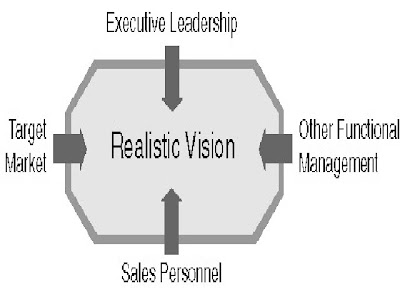
To do this, you will require a team of contributors, as shown in Figure 3-1.
Figure 3-1: Contributions to a realistic vision.
As Lewis Carroll said in Alice in Wonderland, if you don’t care where you are going, you are sure to get there if you walk long enough. Well, maybe in Mr. Carroll’s day, or in Alice’s new world, you could take as long as you needed to get somewhere, but not today! Not in this rapidly changing world of technology-based global business. You just don’t have that much time to reach success, so you’d better start establishing performance objectives and measurements.
One thing to keep in mind is that you cannot do it ‘‘the same old way.’’ That would be like trying to drive an old oversized luxury car from the 1950s today. It may be beautiful to look at and comfortable to ride in, but the quality, gas mileage, and shortage of technologies will make it useless for anything but an antique auto exhibit.
There are four areas to consider when creating or setting performance objectives. These are:
Needs of the business
Performance needs
Training needs
Work environment needs
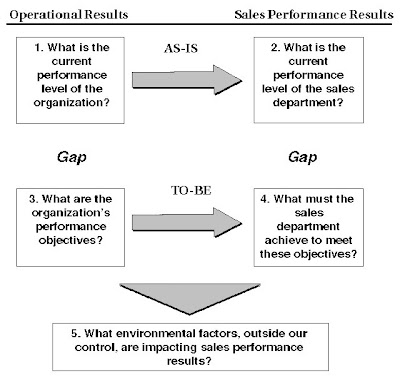
Do you notice the sequence? The order of solutions has usually been found to work best when you follow the above sequence. Remember, the sales department is not an island unto itself. You are performing the sales function to meet some organization-wide need(s), so start with the needs of the business and progress to the needs of the work environment. As you look at any desired performance objective, construct a process improvement analysis that looks like the one in Figure 3-2.
Figure 3-2: Linking performance to gap closure.
Step 1: What Is the Current Performance Level of the Organization?
How are its measurements compared to where they should be right now? How is your overall organization performing against its stated objectives and goals? If you aren’t sure, sit down with the leadership and find out.
What is the current sales organization’s contribution to the organization’s overall current performance? Be honest and explore this subject as you develop your performance improvement plan. Be realistic in a manner that will be relevant to all concerned. Don’t deny or minimize your department’s contribution to a shortfall in goal attainment by the company. At the same time, don’t fall on a sword that is not of your creation. Be honest so that you will be perceived by all as a true member of the organization’s management team.
Step 2: What Is the Current Performance Level of the Sales Department?
Identification of current performance and organizational obstacles. Now that you know what performance levels you need to have as a sales organization, take a look at where you are now. Don’t generalize with such concepts as ‘‘we aren’t very good’’ or ‘‘we don’t make enough sales.’’ Be specific. In what performance areas are you currently lacking, and by exactly how many sales are you falling short? This analysis will give you a starting point to measure success in the coming months and years.
Also, be realistic about organizational obstacles that might make it difficult to improve. Just because these challenges exist, however, does not mean you can treat them as excuses. If it were that easy, anybody could do your job. You are being paid to mitigate or find a way around the obstacles.
Relative importance of all performance results. As you look at the current performance results, identify and categorize them enough to be able to prioritize or rank them in their importance for meeting the desired performance requirements demanded by your answers to Step 1. Everyone is limited by time, money, tools, and people. Make sure that you are working on the performance standards that will have the greatest impact on the successful achievement of your goals. This works for you in two ways. First, it helps keep the entire organization supporting your plans. Second, it keeps your sales team engaged since the performance improvement that you require of them is directly linked to organizational success and is not perceived as just busy work.
Current skills to perform as required. Ask yourself specifically, what are the current skills of the sales team members (or those currently performing the sales function) in areas that have an impact on the highest priorities identified in the last question? If you have a sales team now, analyze each of them individually, not as a team. This will allow you to develop a performance improvement plan for each, rather than grouping them all together in an ill-defined initiative.
Obstacles to performance. Make sure you consider any current obstacles that need to be addressed to reach your, and the organization’s, goals. Be realistic since some of them, such as current compensation models, HR-controlled benefits programs, inadequate product portfolio, insufficient supportive technology, available talent pool, decline in addressable markets, might affect your success.
Skill gaps. This point is very important. Based on your analysis of what is needed to perform at the level required to meet organization or corporate objectives and the current level that the performance is at today, what is the gap? Whether it is per sales person or per the entire team, you now have a starting point, a finish line, and a distance you have to traverse to be successful. This gap will help you set the intermediate goals and milestones of measurement to communicate to the world that you are doing a great job.
Step 3: What Are the Organization’s Performance Objectives?
Identification of internal business goals and challenges. As we said in the previous chapters, a sales manager must always be focused on the organization’s goals, objectives, and challenges. Make sure you have a very clear understanding of the vision for the future held by the leadership of your business, association, or organization. Don’t make assumptions, have preconceived ideas, or jump to conclusions based on partial data. Sit down with your leaders and ask them specifically what performance level would they like to see the organization achieving. Not just the sales team, but the entire organization. Make sure that they discuss their views of what obstacles or challenges might lie in the way.
Identification of customer goals and challenges. Additionally, review your S.W.O.T. on the customer segment you are targeting. Consider the goals and challenges of your most important customers. More than a few successful sales managers have engaged their targeted market in the performance-setting process for their sales team.
Understanding the implications of performance as viewed by both functional management and the customer. The next action for Step 3 is to explore the way your organization’s management team perceives the contribution that the sales organization can make to achieve the overall organizational objective. This is critical! You must understand their view of the role of sales. It might surprise you.
Step 4: What Must the Sales Department Achieve to Meet These Objectives?
Identification of required performance results. Now, find out your required contribution to the organization’s overall goal attainment. You can’t bear the whole burden on your shoulders, but as the initiating department for new orders, you do share a significant portion of the burden for organizational success. Be realistic about what sales performance levels are required of your team and don’t get bogged down in the ‘‘we can’t do that’’ mode of thinking. You can do just about anything if you address realities in your planning. Link your team’s contribution to some form of performance evaluation that is clear, concise, and measurable. Clear means that any reader will be able to understand it. Concise means it is to the point without bombastic wordage. Measurable means you are able to determine the impact. It might be a specific increase in gross margins on the average sale. Or it might be an increase in cost reduction through an increase in order entry quality as measured by returned orders. It could be issues related to customer retention as measured by lost customer rate. It might even be a reduction in internal conflicts between the sales department and other organizational departments as measured by cross-organizational surveys. Remember, if you can’t measure it, it doesn’t belong in the performance standards.
Identification of customer’s required performance model. Spend some time with your most important customers, those you can’t afford to lose, and find out what they require in a sales professional that provides solutions to their business challenges. Make sure you focus on the field and hierarchal level you are selling into, such as IT management or enterprise-wide directorships, so the data will be clear about the point of interaction.
Identification of senior management’s required performance model. Here we are analyzing, in partnership with our senior management, the requirements for a sales performance model. In other words, we understand from previous questions how they perceive the sales department in regard to its contribution to overall organizational success. But what departmental design or model do they require? In some organizations, the senior management or leadership demands accessibility to the sales team with some form of ability to influence daily activities. In other organizations, senior management prefers that the sales team be part of the marketing department or customer service. In others, you might have complete autonomy and independence. You can’t simply shape a perfect sales model and establish performance objectives without senior management’s input on a required or desired departmental model.
Agreement with sales personnel for skills development actions. Whether they are new kids out of the gate or old seasoned veterans, you now have the basis for communicating to your sales personnel a plan for improving the skills that are necessary to meet organization goals and objectives, as outlined in individual performance improvement plans. You will get a greater acceptance of the plan and an agreement by your team to being measured by the new standards of performance because they are directly linked to the goals of the organization as a whole.
Agreement with senior management for skills development actions. To ensure the support and confidence of your senior management team, as well as cross-organizational support, gain the agreement of your leadership to your specific plan of action to improve performance results. As you might be aware, leaders do not like surprises, and if they encounter any, you surely don’t want them to come from your sales plan.
Step 5: What Environmental Factors Outside Your Control Are Impacting Performance Results? What is the current state of your organization? As you step back and look at your company or association, what are the realities? I have been called in many times to work with companies that are in decline because of a lack of interest by the ownership or a disappearing target market. I’ve also been called in to situations where the global companies are challenged to communicate effectively in diverse cultures, where there is a demand for different approaches to success in localized markets. I don’t mean that we just give up in these situations, but we must incorporate them into a plan that accounts for any realities we need to work around and through if we want to attain success.
What is the current state of the business drivers we talked about in Chapters 1 and 2? Remember the business drivers? The current, trending, and future of each must be incorporated in your sales plan if it is to have any validity.
Technology (hardware and/or software)
Globalization
Competition
Customers
Demographics
Lifestyles
Psychographics (consumer sentiment)
Firmographics (business sentiment)
Economy
Regulatory practices
Business practices
Be honest and explore each of the previous questions as you develop your performance improvement plans, and as you do, ask yourself the following questions:
How good is your business intent? Is it in complete alignment with all realities?
What are the key business drivers mentioned previously that will have the greatest impact on success?
What do you know about the internal environment? Do you need to know more, and where will you go to get that information?
What do you know about the external environment? Do you need to know more, and where will you go to get that information?
Raising the Bar for Existing Sales Team Members
As you set performance standards for your team members, you must establish ones that will drive a higher and higher level of performance from your existing sales personnel. As I mentioned previously, you cannot do this as a group, but rather from the unique individuality of each person. No matter what you are creating as a new expectation, each person will be starting from a different point in his or her control and understanding of the performance skill set.
Measure where your team members are, where you want them to be, how much time is available to improve their performance skills, and what their rate of learning is. Also, develop a performance improvement plan that is based on where you want them to be both in the short term and twelve months from now.
The one key to performance improvement for existing team members is that they must recognize and understand the relevance of the performance standard to the business environment. If they don’t, they will be hesitant and resistant.
Using the New Performance Standards to Hire
It can be much easier to set standards for the new hires. Add any required performance skills to a list you will be creating in the next chapter. It will make hiring much easier since you can now specifically measure all possible candidates, both internal and external, against a valuable competencies scale.
But, remember, you cannot have a performance standard for new hires that is different from the one for existing team members. This will only lead to dissatisfaction and complications in the compensation program, as well as possible legal problems for you and the company. Make sure that you are being fair to all team members.
In this chapter we discussed the need for establishing clear, reasonable performance measurements for each and every team member. Rather then being constructed arbitrarily, this is done by linking the approach to internal and external factors, gap analysis, and the overall organizational business plan. The resulting performance analysis can be used both to raise the bar for existing team members and to set equally high standards for new hires.